Yes, you can serve underhand in tennis, because ITF Rule 16 allows a hand release in any direction. The 2026 edition adds one condition on contact, which is a hit before the ball bounces. The serve must also clear the net and land in the diagonal service box. Underhand serving is legal for juniors and adults, and only etiquette stays open to debate.
Key Takeaways
- Rule 16 of the ITF Rules of Tennis 2026 requires no overhand motion, so an underhand serve is legal.
- The ball must be hit before it touches the ground, and letting it bounce first is a fault.
- Stance, foot fault, service box and two-fault rules apply to an underhand serve exactly as they do to any serve.
- Etiquette is a matter of opinion, because the rules never require a warning before an underhand serve.
- A low, soft, sliced underhand serve with a short landing spot is the version we coach.
Can You Serve Underhand in Tennis Under the ITF Rules?
Yes, you can serve underhand in tennis under the ITF Rules of Tennis, because Rule 16 sets no required arm motion. The server stands behind the baseline, releases the ball by hand, and hits it before it touches the ground. The rule never uses the word underhand, so any release direction counts. The 2026 edition states this in plain terms.
The United States Tennis Association (USTA) gives the same answer. It notes that the release can travel upward or downward and still be legal. We explain this rule during focused lessons sessions, because players hear mixed opinions at the club.
The International Tennis Federation (ITF), now World Tennis, publishes the Rules of Tennis. Tennis Canada and the Ontario Tennis Association are the national and provincial bodies that players in Ontario will hear about. The next section looks at the exact wording of Rule 16.
Does a Serve Have to Be Overhand?
No, a serve does not have to be overhand. Rule 16 needs only a hand release and a hit before the bounce. The rule describes the stance, the release and the contact. It says nothing about shoulders, elbows or swing paths.
Rule 16 also covers players who have the use of only one arm. Such a player may use the racket to release the ball. That detail shows how open the wording is. The table below compares each part of Rule 16 with what an underhand server does.
| Part of the serve | What Rule 16 requires | Underhand server |
|---|---|---|
| Starting position | Both feet at rest behind the baseline, inside the centre mark and sideline extensions | Same position as any serve |
| Ball release | Release by hand in any direction | Drops the ball low, in front of the body |
| Contact | Racket hits the ball before it touches the ground | Swings from low to high through the ball |
| End of the motion | Racket hits or misses the ball | Same ending as any serve |
Every row ends with the same answer, which is that an underhand server meets the rule. The only open question left is whether the rule bans the serve outright.
Is the Underhand Serve Banned in Tennis?
No, the underhand serve is not banned in tennis, and no rule lists it as a fault. The USTA answered a reader with an injured shoulder by confirming that the rules allow underhand serving. It also pointed the reader to Rule 16 in the Friend at Court, the USTA rules handbook.
A ban would need to appear in the rulebook, and the rulebook contains none. Local events can publish their own conditions of play, so players check the entry details for a tournament or league. A club match in Toronto starts from the same base rules.
Legal does not mean exempt from the other rules. The serve still has to meet every other rule that governs service, which the next section lists.
Which Underhand Serve in Tennis Rules Still Apply?
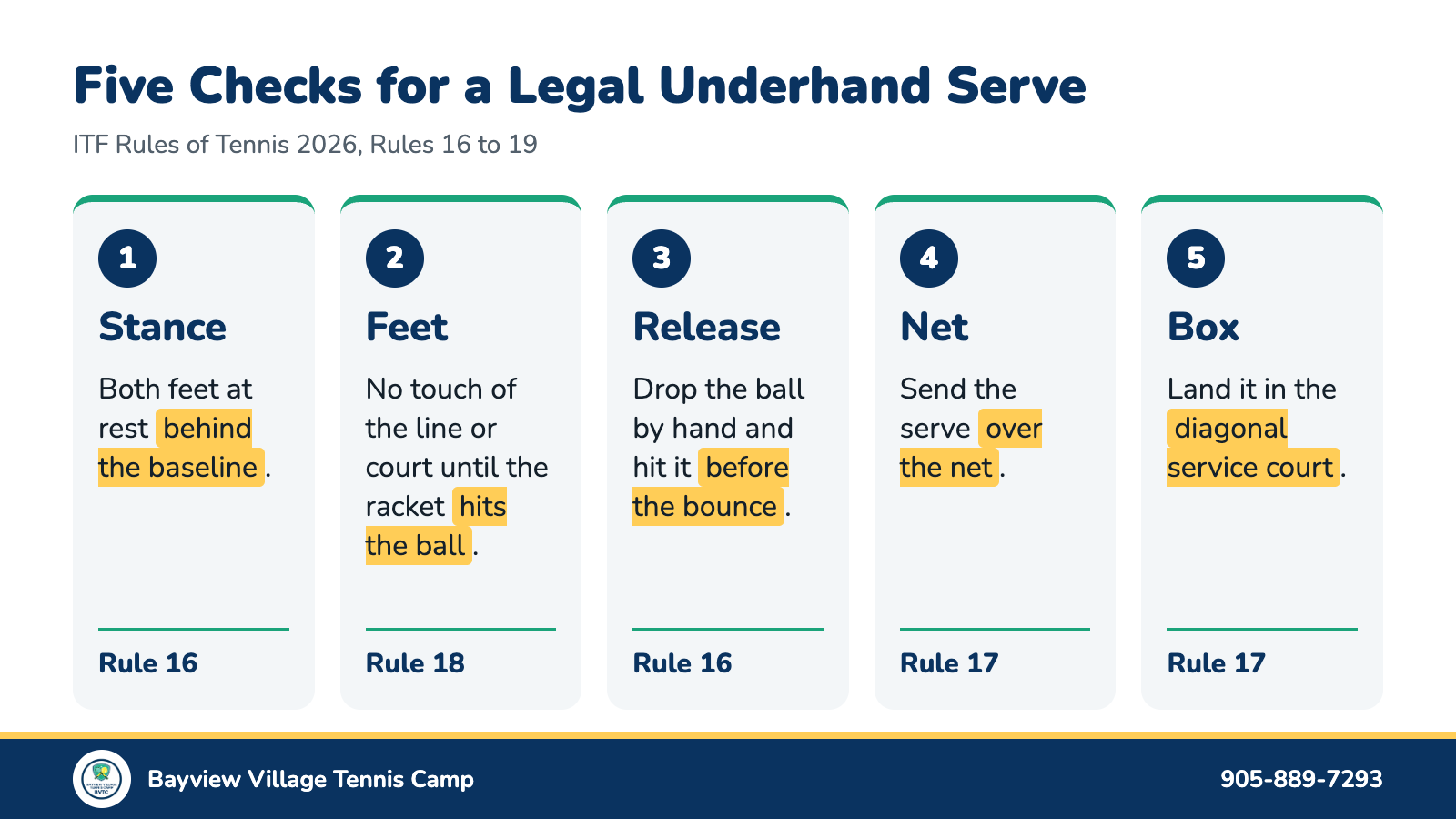
The underhand serve in tennis rules that still apply are the stance, foot fault, service box, net and two-fault rules. Rules 16 to 24 treat every serve the same way. Five checks keep an underhand serve legal.
- Stand at rest with both feet behind the baseline and inside the centre mark and sideline extensions.
- Keep both feet off the baseline and the court until the racket hits the ball (Rule 18, the foot fault rule).
- Release the ball by hand and hit it before it touches the ground.
- Send the ball over the net.
- Land the ball in the service court diagonally opposite the server (Rule 17).
The graphic below shows the same five checks as a quick card for the court.
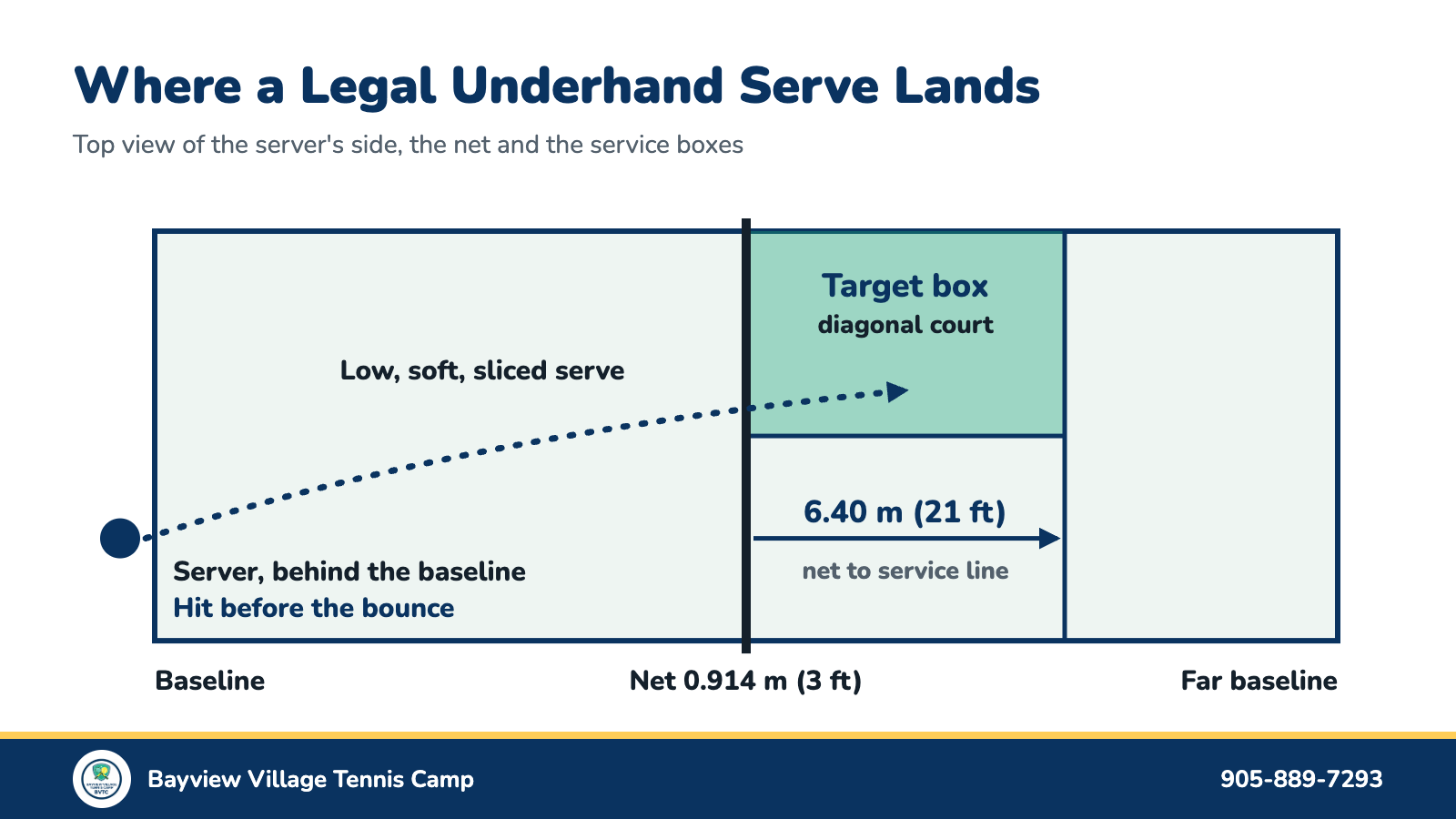
The service line sits 6.40 metres (21 feet) from the net. The net stands 0.914 metres (3 feet) high at the centre. A soft underhand serve has a short target as a result. Our guide to service boxes shows where each line sits.
A first serve that is a fault gives the server a second serve from the same half of the court. Two consecutive faults lose the point under Rule 24. Learners who want to cut serve faults can read how that rule plays out on court.
What Counts as an Illegal Serve in Tennis?
An illegal serve in tennis counts as a service fault, and Rule 19 lists four ways to commit one. The first is breaking Rule 16, 17 or 18, which covers the stance, the diagonal court and the foot fault. The other three are shown below.
- The server misses the ball while trying to hit it.
- The served ball touches a permanent fixture, a singles stick or a net post before it hits the ground.
- The served ball touches the server, the server’s partner, or anything either one wears or carries.
Letting the ball bounce before the hit breaks Rule 16, so that serve is a fault. This slip catches players who bring habits from other sports. Tossing the ball and then catching it is not a fault under Rule 19. The server may also let it bounce, and then start again.
A fault is not the same as a let. A let happens when the ball touches the net and is otherwise good, and the server serves again.
Is Underarm Serve Allowed in Tennis for Juniors and Adults?
Underarm serve is allowed in tennis for juniors and adults, because Rule 16 applies to every player in the same way. The rule has no age limit and no skill limit. A beginner and an adult club player follow the same service rules.
Tennis Canada also says the serve in red-ball tennis can be underhand or overhead. Red ball is the first stage of progressive tennis, which Tennis Canada lists for players 8 and under. Players who ask can you serve underhand in tennis at a junior event hear the same answer as adults. Players on a red stage court play on one quarter of a full court.
The rule stays the same as players move up to bigger courts. Only the ball, the court and the racket size change. Opinions about the serve change too, and the next section explains why.
Why Is Underarm Serve in Tennis Disrespectful?
Some players see an underarm serve in tennis as disrespectful because it can look like a comment on where the receiver stands. That feeling is an etiquette view and not a rule. Rule 16 contains no duty to warn the receiver and no ban on the serve.
The receiver also holds a legal answer. Rule 8 allows the receiver to take any position, inside or outside the lines on the receiver’s side of the net. A receiver who steps in closer takes away the short serve. The server then needs a different plan.
Etiquette still matters in friendly games and junior events. Players who want a calm match can review the basics of tennis etiquette before they try a surprise serve.
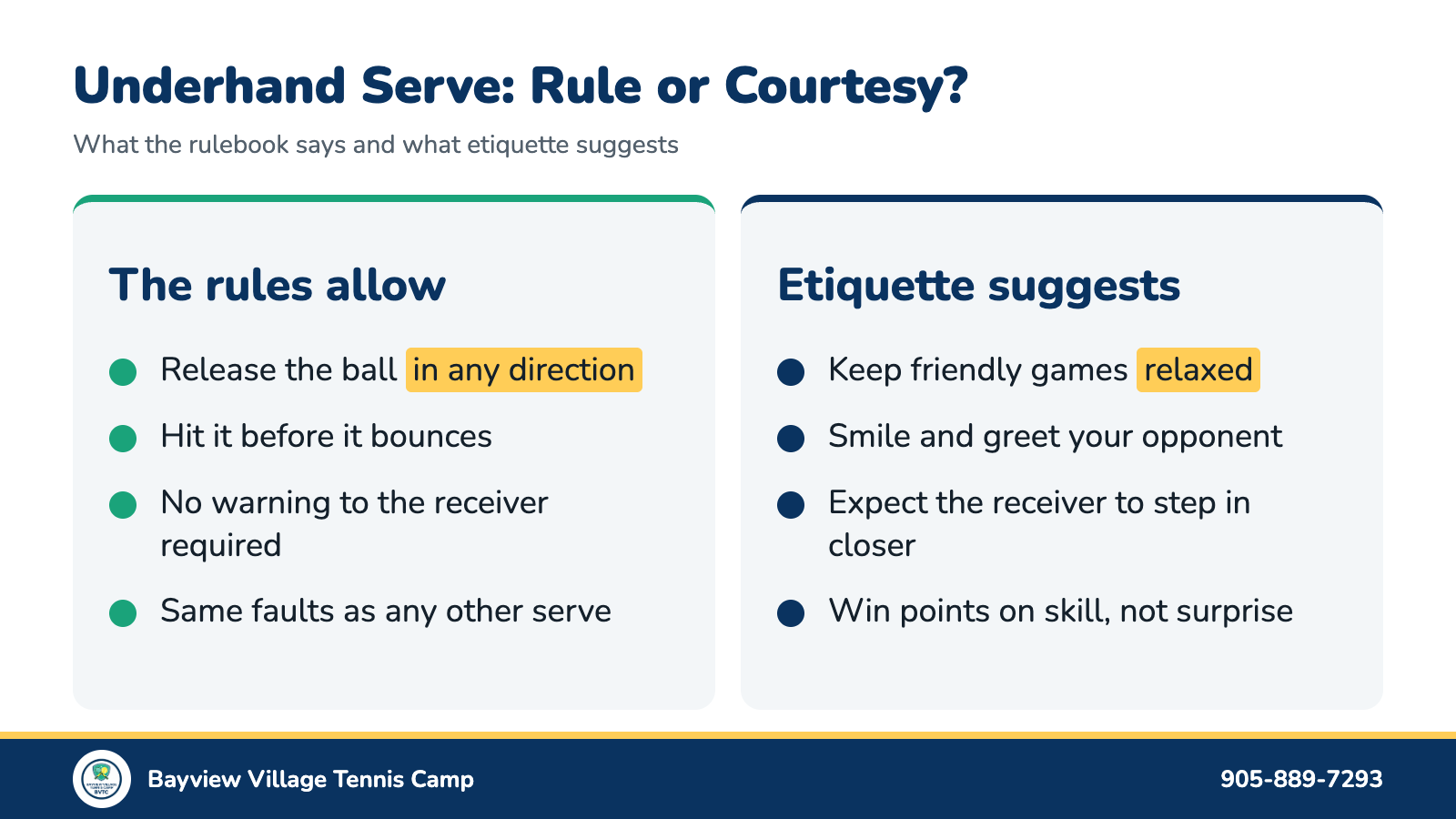
The panel above separates what the rules allow from what etiquette suggests. A server who keeps both columns in mind stays legal and stays friendly. Juniors learn the same balance through fair play habits.
How to Do Underhand Serve in Tennis Step by Step
Stand behind the baseline, drop the ball low, and swing from low to high to do an underhand serve. Three cues cover the whole motion, and every cue follows Rule 16.
- Set up: Place both feet behind the baseline, hold the racket low, and keep the ball in the other hand.
- Release: Drop the ball by hand below hip height, a short step in front of the hitting side.
- Brush: Swing from low to high and brush the back of the ball with the racket face tilted slightly open.
The ball must be hit before it bounces, so the timing is quick. A coach can steady the timing with short repeats. Parents who want a home routine can follow our notes on teaching a serve to a child.
Feet stay still during the swing. Rule 18 treats walking, running and touching the baseline as a foot fault, and slight foot movements remain allowed. The diagram below shows where a low underhand serve travels and lands.
What Is an Underhand Slice Serve?
An underhand slice serve is an underhand serve hit with sidespin or backspin, so the ball skids low after it bounces. The spin comes from brushing across the back of the ball instead of hitting it flat. A low bounce gives the receiver less time to reach the ball.
The racket face stays open and the swing path stays smooth. A hard swing sends the ball long, so the pace stays gentle. The overhead version of this spin has its own steps in our sidespin serve article.
What Is the Best Underhand Serve Tennis Players Can Hit?
The best underhand serve tennis players can hit is the one that lands inside the service box and stays low. We coach a soft slice that clears the net by a small margin and lands short in the box. The serve keeps the point alive instead of ending it with a fault.
The same idea works for the second serve, where one more fault loses the point. Players who want a personal plan can book one-to-one lessons and rehearse the serve with a Tennis Canada certified coach.
Common Underhand Serve Mistakes and How to Fix Them
Common underhand serve mistakes include a bounced ball, a foot on the line, a hard swing and a wrong-box serve. Each mistake has a simple fix. The list below pairs the error with its correction.
- Bouncing the ball first: Release the ball lower and swing sooner, because Rule 16 needs contact before the bounce.
- Stepping on the baseline: Start one small step behind the line, since touching the line during the motion is a foot fault.
- Swinging too hard: Shorten the swing and trust the spin, so the ball lands inside the service line.
- Serving into the wrong box: Check the half of the court first. The server starts from the right half and then alternates sides.
Practice sessions fix these errors faster than match play does. A coach watches the release height and the feet at the same time. That review makes the serve repeatable, and the next section covers the side questions players ask.
What Else Should You Know About the Underhand Serve?
When Should a Beginner Use an Underhand Serve?
A beginner or child should use an underhand serve when the overhead motion stops points from starting. The serve gives the learner a legal way to put the ball in play. Overhead serving can follow once the toss and swing feel steady.
Does an Underhand Serve Work as a Surprise Tactic?
An underhand serve works as a surprise tactic when the receiver stands deep behind the baseline. A short, low serve pulls that receiver forward and changes the rhythm of the point. The tactic carries a risk, because a receiver who steps in can attack a weak serve. Players save it for moments when a change of pace helps, and they keep a regular serve ready.
Can a Sore Shoulder Be a Reason to Serve Underhand?
A sore shoulder can be a reason to serve underhand, because the legal motion needs no overhead reach. The USTA answered an injured-shoulder question by confirming the rules allow it. This is general education only. Players with pain should talk to a doctor or physiotherapist, and a coach can then adjust the lesson. Our guide to injury prevention covers safe habits for young players.
Do Pickleball Serving Rules Apply on a Tennis Court?
Pickleball serving rules do not apply on a tennis court, because Rule 16 governs every tennis serve. A tennis server must hit the ball before it bounces. Players who play both sports keep the two rule sets separate.
Frequently Asked Questions About the Underhand Serve
How Many Serves Do You Get in Tennis?
You get two serves on each point in tennis. An underhand serve counts as one of them. The server loses the point after two consecutive faults.
Where Do You Stand to Serve in Tennis?
You stand behind the baseline and inside the imaginary extensions of the centre mark and the sideline. Both feet must be at rest before the motion starts. An underhand server uses the same spot as any other server.
Does the Server Have to Wait for the Receiver to Be Ready?
The server has to wait for the receiver to be ready under Rule 21. A receiver who attempts a return counts as ready. A surprise underhand serve is legal only when the receiver is ready.
Can You Hit the Net on a Serve and Still Have It Count?
A serve that hits the net and is otherwise good is a let, and the server serves again. A let does not cancel an earlier fault. A serve that touches the net and lands outside the service box is a fault. The server then takes the second serve from the same half of the court.
How Bayview Village Tennis Camp Coaches Juniors and Adults on the Serve
We teach the serve in our junior summer camp, our fall and spring junior programs, private lessons and adult group lessons. Tennis Canada certified coaches lead every session. Players across North York learn the legal underhand serve first when they need a simple start. They then move toward the overhead motion at a pace that suits them.
Our adult group classes include the same serve practice. Adults who return to the game after a break use the underhand serve to rebuild timing before they add power.
Call us on 905-889-7293 to talk through a serve plan for your child or for yourself. We will suggest a program and a starting point that suit the player, whatever the age or the level of experience.
Players who ask can you serve underhand in tennis leave with a clear answer and a plan to practise it. The BVTC coaches are ready to help.