
Tennis doubles rules put two players on each side of a court that is 10.97 metres (36 feet) wide. Partners take turns serving and keep fixed receiving sides for the whole set. Scoring matches singles, with a few formats chosen by the event. The International Tennis Federation (ITF) Rules of Tennis define every step, and this page walks through each one in order.
Key Takeaways
- A doubles team has two players, and both share one side of the 10.97 metre (36 foot) wide court.
- Each player serves once every four games, and the serving order resets only at the start of a set.
- Receiving partners keep their sides for the full set and alternate points.
- Doubles matches are best of 3 or best of 5 sets, and the third set may become a 10-point match tiebreak.
- Both partners touching the same ball loses the point.
What Are the Basic Rules of Doubles Tennis?
The basic rules of doubles tennis cover four areas. Those areas are two players per team, a wider court, a fixed serving rotation and a fixed receiving order. Each team must keep its order for the whole set, under ITF Rules 14 and 15. Every other rule in a doubles match builds on that order.
After the return of serve, either partner can hit the ball, and partners do not have to alternate shots. Players who want coached practice with these rules can join our coached programs during the year. The next section shows how the court itself changes.
What Is the Difference Between Singles and Doubles Tennis?
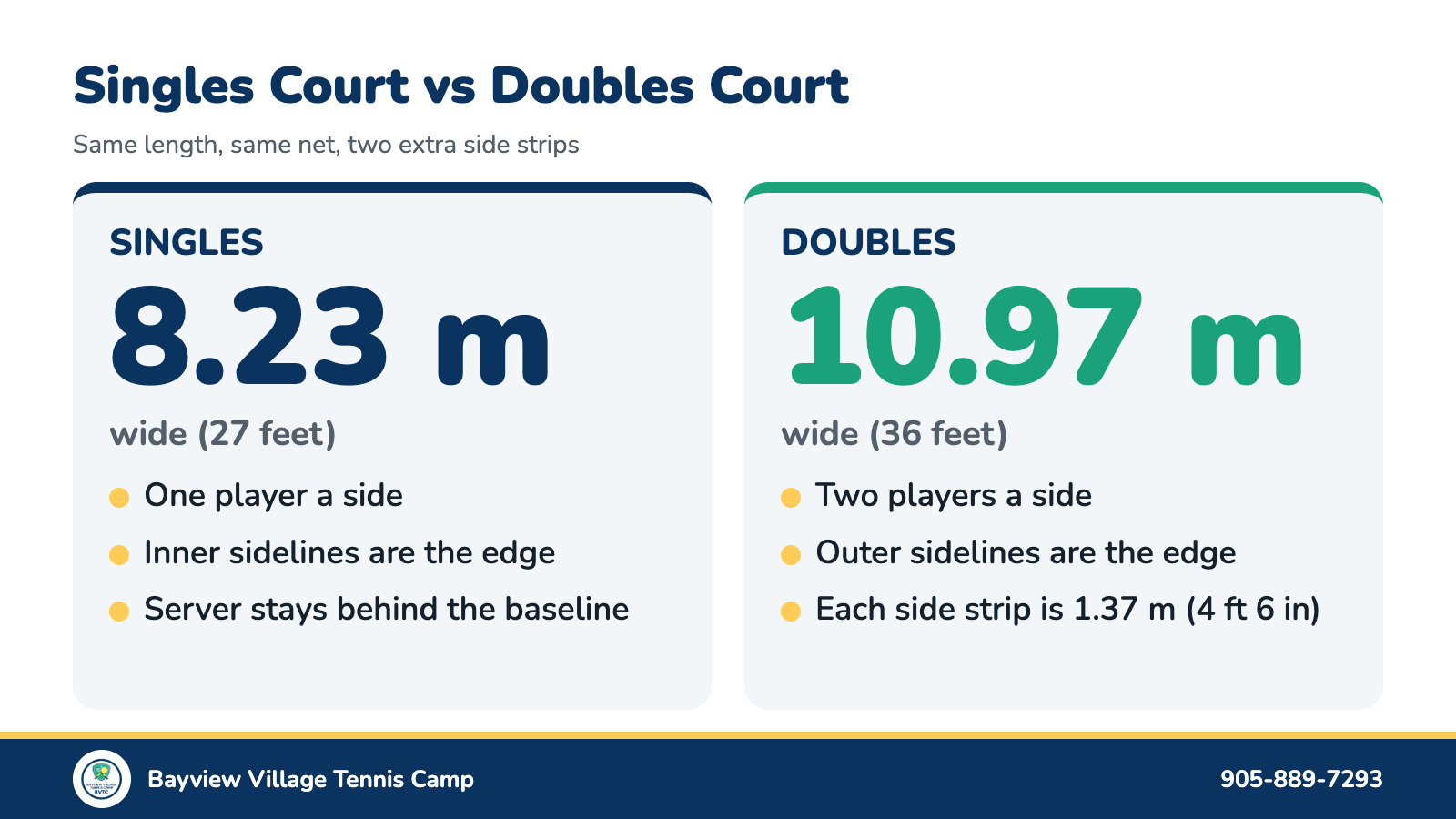
The difference between singles and doubles tennis is the number of players and the width of the court. Doubles adds a side strip on each side. That makes the court 10.97 metres (36 feet) wide instead of 8.23 metres (27 feet). The net, the length and the service boxes stay the same.
Each side strip is 1.37 metres (4 feet 6 inches) wide, and players call it the alley or tramline. The table compares the main rules in both formats.
| Rule | Singles | Doubles |
|---|---|---|
| Players per side | One | Two |
| Court width | 8.23 m (27 ft) | 10.97 m (36 ft) |
| Server position | Inside the singles sideline extension | May stand between the singles and doubles sidelines |
| Serving turns | Players alternate games | Partners rotate within each team |
| Receiving turns | One receiver | Partners alternate points |
The graphic below shows both court widths and the size of each side strip.
For exact line positions, our court measurements article lists every marking. The serving rules come next.
Tennis Doubles Rules for Beginners Step by Step
New players can learn doubles by following a short game routine that repeats every game. The routine has six steps, and each one comes from the ITF Rules of Tennis.
- The team due to serve first in the set decides which partner serves.
- The server stands behind the baseline and serves into the diagonal service box.
- The receiver returns the ball, and then either partner can hit it.
- Only one partner may touch each ball, or the team loses the point.
- The other team serves the next game, with its own partners taking turns.
- Both teams swap ends once game one finishes, and again after each later odd game.
A short example shows the routine in play. Player A serves game 1 from behind the baseline, and Player C returns from the deuce side. Player D then receives the second point from the other side. Either partner on Team 1 can hit the next ball.
Beginners who master that routine can play a full doubles match. Our basic tennis rules post covers the singles basics that sit underneath it. The serving rotation is the next piece.
Tennis Doubles Rules Serving Order and Rotation
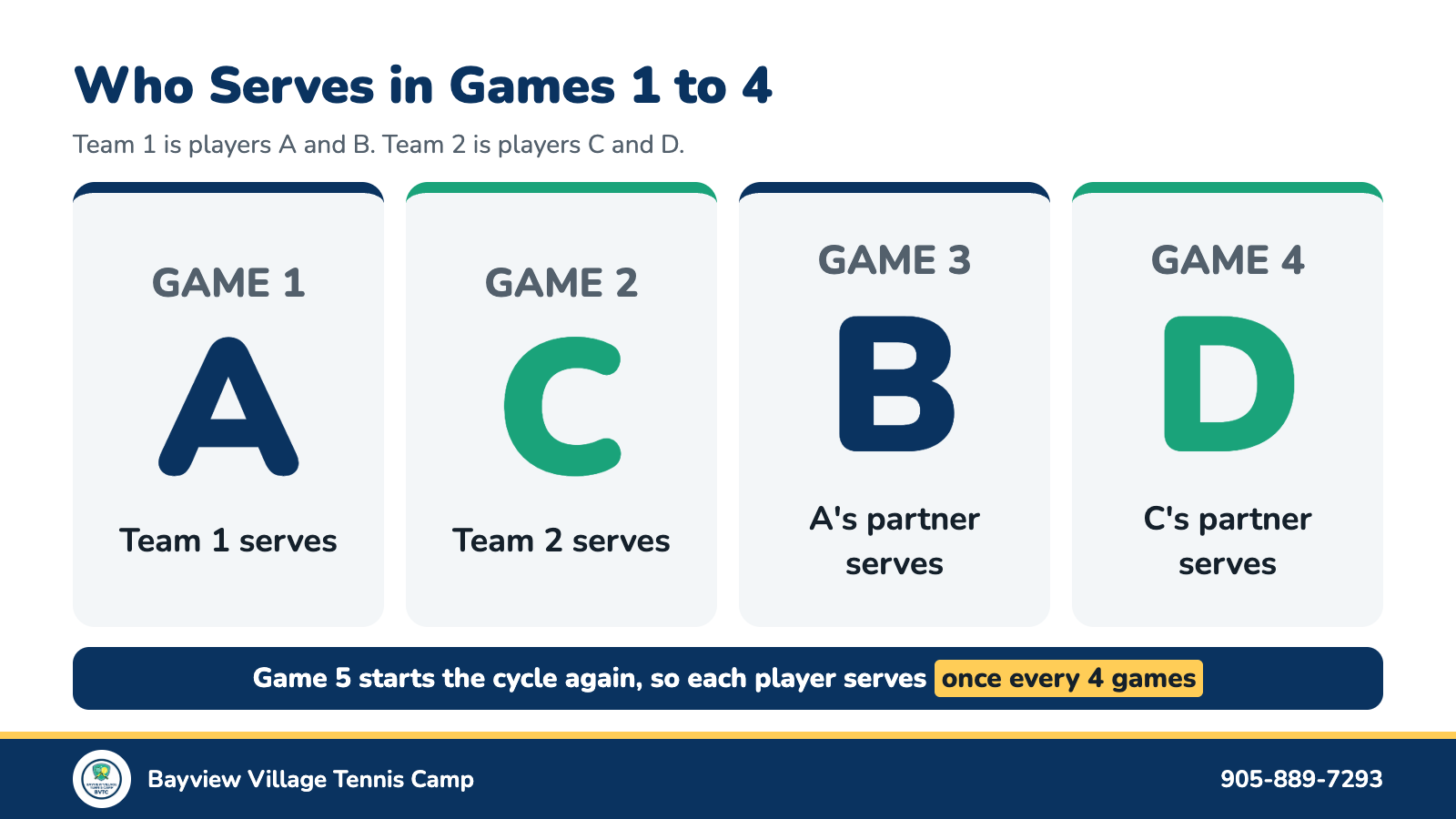
Doubles serving order gives each partner a turn in a repeating four-game cycle. Each player serves once every four games, according to HEAD and the ITF Rules of Tennis. Team 1 serves game 1, Team 2 serves game 2, and the partners follow in games 3 and 4.
The graphic below labels the four players A, B, C and D and shows who serves each game.
A server who starts a game serves the whole game, and the partner waits for the next turn. That cycle repeats until the set ends.
Serving also alternates between halves of the court. The server starts each game from the right half and alternates after every point. The first serve of a doubles game therefore goes to the receiver in the diagonal box.
Who Serves First in Doubles Tennis?
The team due to serve in the first game of each set decides which player serves first in doubles tennis. That team picks one of its two partners, as ITF Rule 14 states. The opponents then choose their own server for game 2.
The United States Tennis Association (USTA) adds that a team may change this order at the start of every set. The order stays locked once the set begins.
Tennis Doubles Rules Receiving Order and Sides
Doubles receiving order alternates between the two receiving partners after every point. The receiver’s partner takes the second point, under ITF Rule 15. That pattern continues to the end of the game and the set. Each partner therefore keeps one side of the court.
The USTA states that the same receiving sides stay in place for the entire set. Partners may swap sides only at the start of the next set. Good returns win games, and our returning tips tips show how to build them.
Where Do You Stand When Receiving in Doubles?
You stand on your assigned side of the receiving team’s court when receiving in doubles. Your partner may stand anywhere on that side, because the rules fix the order and leave the position open. The receiver may also stand inside or outside the lines.
The serve must still land in the service box diagonally across the net. A partner who is hit by the serve before the bounce loses the point for the team.
Tennis Doubles Positioning Rules After the Return
Tennis doubles positioning rules allow either partner to hit the ball once the return is made. Neither player has a fixed zone on court after that return. Both partners cannot touch the same ball, but they can cover any part of their side.
Formations are a strategy topic, so we cover them in our strategy guide for doubles. Scoring is the next rule set.
Tennis Doubles Rules Scoring From Points to Sets
Doubles scoring uses the same points, games and sets as singles. The event announces the scoring format in advance, as ITF Rule 6 requires. Players should confirm the format before the first serve.
The table lists the formats that doubles players meet most in club and school events.
| Format | How it works | Where it applies |
|---|---|---|
| Advantage set | First to 6 games, with a two-game margin | Standard sets |
| Tiebreak set | Tiebreak game at 6 games all, first to 7 points | Standard sets |
| No-ad | One deciding point at deuce | Games |
| Match tiebreak | First to 10 points, with a two-point margin | Replaces the final set |
Both partners on a team share the same score. Our deuce scoring article explains the point names in more detail. The next question is about deuce itself.
Does Tennis Doubles Have Deuce?
Yes, a standard doubles game has deuce, and the score works as it does in singles. A team must win by two points once the game is level. The only change is the no-ad option below.
Deuce is called when each team has won three points. The two-point margin then decides the game. Each point keeps the same server, and the same partner receives on the same side.
What Is the No-Ad Scoring Rule in Doubles?
The no-ad scoring rule in doubles replaces deuce with a single deciding point. The receiving team wins or loses the game on that one point, under ITF Appendix VI. The receivers choose which half of the court they receive in.
The receiving partners cannot swap positions for that deciding point. In mixed doubles, the player of the same gender as the server receives it.
How Many Sets Are in a Doubles Tennis Match?
A doubles tennis match has three sets in the short format and five sets in the long format. The winning team needs 2 sets or 3 sets, as ITF Rule 7 sets out. A best of 3 match needs 2 sets, and a best of 5 match needs 3. The event picks the format before play.
Junior events can shorten this format with a short set or a timed match. Tennis Canada and the ITF describe those formats for young players. The next section shows how a team wins.
How Do You Win Doubles in Tennis?
You win doubles in tennis by winning the required number of sets before the other team does. Win 2 sets in a best of 3 match or 3 sets in a best of 5 match. A team wins a set by taking six games with a two-game margin.
A tiebreak decides a set at six games all. The first team to reach 7 points wins it with a two-point lead. Each tiebreak point still follows the doubles serving rotation. The last set has its own format, covered next.
In a tiebreak, the player due to serve takes the first point. The opposing team then serves the next two points, and the teams alternate every two points. Each partner serves in the same order as during the set, and the teams change ends after every six points.
Tennis Doubles Rules 3Rd Set and the Match Tiebreak
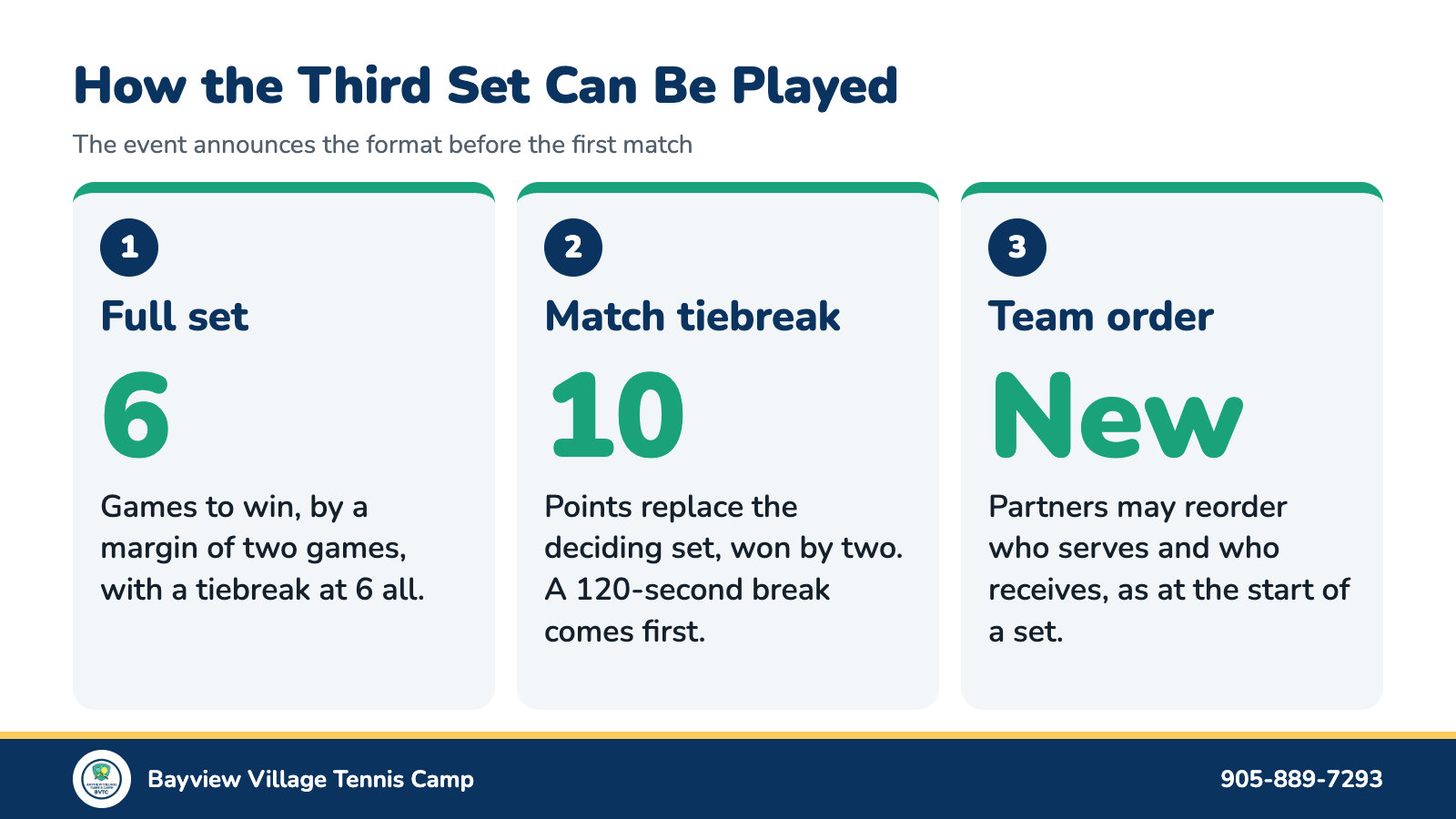
The third set in doubles may be a full set or a 10-point match tiebreak, depending on the event. A match tiebreak replaces the deciding set and goes to 10 points with a two-point margin. Nike and HEAD both describe this format for doubles.
The ITF Rules of Tennis add a 120-second break before the match tiebreak, and balls are not changed before it. Partners may also change their serving and receiving order, as at the start of a set. The graphic below shows the three parts of this decision.
That choice of order matters, so players should agree on it during the break. Several common errors follow from missing it.
Common Doubles Rule Mistakes and Their Penalties
Common doubles rule mistakes cost a point or a service. Each mistake has a set penalty in the ITF Rules of Tennis. The list shows the main cases for new teams.
- The wrong partner serves out of turn, and the order is corrected.
- Both partners touch the ball on one return, and the team loses the point.
- The serve hits the server’s partner, and the serve is a fault.
- The serve hits the receiver or the receiver’s partner before it bounces, and the server wins the point.
- One partner tries to play alone against the other team, which the rules do not allow.
Several of these errors come from losing track of whose turn it is. Partners can confirm the order at each changeover. Clear calls between partners also help, and our doubles communication post explains how. A short set of related questions follows.
Do Junior Doubles Rules Change by Ball Stage?
Junior doubles rules follow the same basic structure at every ball stage, but the court size and scoring format change. Tennis Canada lists red, orange and green stages that scale the game for players 10 and under. Each stage uses a lower net and a smaller court until the full court.
- Red uses about one quarter of a full court and a lower net.
- Orange uses about three quarters of a full court and a lower net.
- Green uses the full court and a regular net, and all the basic rules of tennis apply.
Young players can learn partner turns and receiving sides at the red stage. Our red level article explains how that stage works. Parents can then watch each child move up a stage.
What Else Should You Know About Doubles Tennis Rules?
What Are the Doubles Court Lines?
The doubles court lines are the outer sidelines, the baselines, the service lines and the centre service line. The outer sideline marks the 10.97 metre (36 foot) width. The inner sideline still marks the service box.
Can One Partner Play Alone Against a Team?
No, one partner cannot play alone against a doubles team. ITF Rule 15 Case 1 gives that answer. Both partners must take part.
Does Mixed Doubles Change the Rules?
Mixed doubles keeps the same rules, with one change for the deciding no-ad point. The player of the same gender as the server receives it. Our mixed teams post covers more detail.
Frequently Asked Questions About Doubles Tennis Rules
How Are Doubles Decided in Tennis?
Doubles are decided by the number of sets each team wins. A best of 3 match needs 2 sets, and a best of 5 match needs 3 sets. A match tiebreak to 10 points can replace the last set.
What Is the New Doubles Format in Tennis?
The ITF Rules of Tennis list several alternative scoring methods in Appendix VI. They include no-ad scoring, short sets and the 10-point match tiebreak. The event organizer announces which one applies before the match.
How Bayview Village Tennis Camp Teaches Doubles Rules
Bayview Village Tennis Camp teaches doubles rules on court with live play, led by Tennis Canada certified coaches. We run a day camp in summer, along with fall and spring junior programs, private lessons and adult group lessons. Families in North York can choose the format that suits each player.
Coaches walk new partners through the serving rotation, the receiving order and the scoring format before the first game. Players then practise those rules in short matches with a coach nearby. Adults can build match skills in our adult doubles sessions, and we offer memberships too.
Coaches can also answer rule questions during any session, from who serves next to how a match tiebreak starts. Compare every option through our full programs page.
Call us at 905-889-7293 to ask about a spot for your player.
Doubles rewards partners who learn the rules together. Every junior or adult can start at a fitting level through Bayview tennis.