Green ball tennis is Stage 1, the last step before the yellow ball. Tennis Canada lists it for kids 10 and under and for teen and adult players rated 1.5 to 2.0. The International Tennis Federation (ITF) rates the ball about 25% slower than yellow, played on a full 23.77 metre (78 foot) court. That makes it a rally-level stage, not a first-lesson stage.
Key Takeaways
- Green is Stage 1 of progressive tennis, the final step before the standard yellow ball.
- Tennis Canada pairs green with kids 10 and under and with teen and adult players rated 1.5 to 2.0.
- The court is full size: 23.77 by 8.23 metres (78 by 27 feet), with a 0.914 metre (36 inch) net.
- The ITF rates the green ball about 25% slower than a yellow ball.
- Coaches judge readiness for yellow by movement and shot control, not by birthday.
What Does Green Ball Mean in Tennis?
Green ball in tennis means Stage 1, the final slower-ball stage before players move to the standard yellow ball. The ITF built these stages for players aged 10-and-under. Since 2012, its Rules of Tennis have required red, orange or green balls for that age group. Green sits last on that ladder, so players arrive with rally skill from orange. ITF events for the youngest age group adopted the format by 2012, two years after the USTA introduced it.
Tennis Canada calls this approach progressive tennis. It describes a set of adaptations that make tennis more accessible, enjoyable and easier to play. The Rogers First Set program from Tennis Canada uses the same progressive approach for kids.
Parents can ask our coaches how a child is placed on a stage through the spring junior lessons at Bayview Village. Placement follows what the child can do on court, not the age on the calendar. That keeps every player challenged without feeling lost.
Players climb from the red ball stage through orange to green. Each step makes the court longer and the ball faster. Green is where the court and the net reach full size.
What Is a Green Dot Tennis Ball?
A green dot tennis ball is the same Stage 1 ball that many programs simply call the green ball. The ITF lists it as a felt ball 6.3 to 6.86 centimetres across. The ITF also describes it as about 25% slower than a yellow ball, an estimated speed. Both names point to one stage.
Which Skill Level Fits Green Ball Players?
Green ball players fit the skill level just above orange, where rallies hold together on a full court. Tennis Canada lists the kids version for players 10 and under. The teen and adult version fits players rated 1.5 to 2.0.
The table below pairs each Tennis Canada ball stage with a kids band, a teen and adult rating and a court size.
| Stage | Kids version | Teen and adult version | Court |
|---|---|---|---|
| Red | 8 and under | Rated 1.0 | One quarter of a full court |
| Orange | 9 and under | Rated 1.0 to 1.5 | Three quarters of a full court |
| Green | 10 and under | Rated 1.5 to 2.0 | Full court |
Green is the only stage in that table played on the whole court. A player at this level covers more ground and keeps the ball in play for longer. The tennis ratings guide explains what numbers such as 1.5 and 2.0 describe.
Before a player starts on green, our coaches look for four skills. The graphic below shows them as a short readiness checklist.
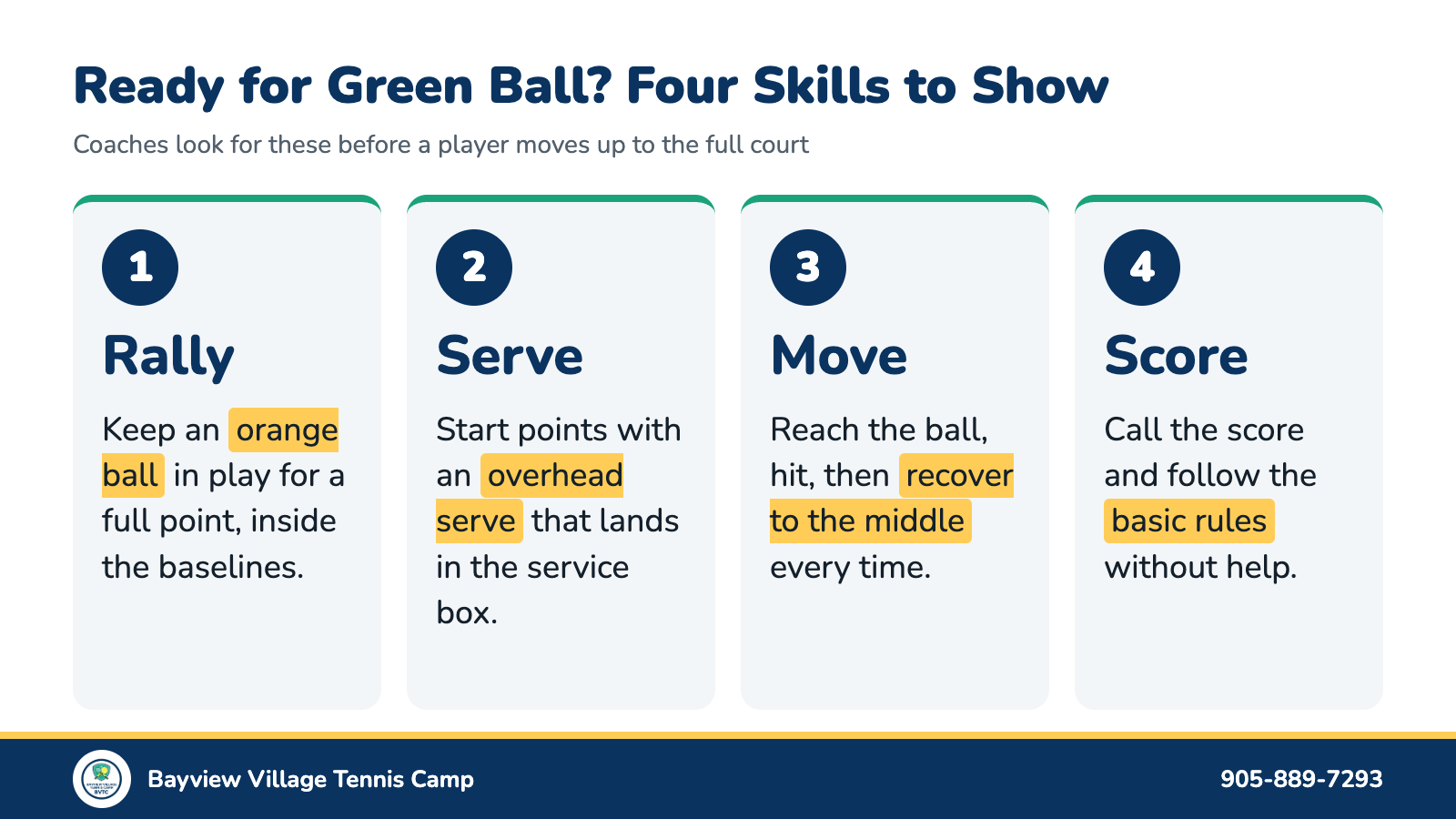
- Rally with an orange ball for a full point, keeping the ball inside the baselines.
- Start points with an overhead serve that lands in the service box.
- Move to the ball and recover to the middle after each shot.
- Call the score and follow the basic rules without a coach stepping in.
Green players hold a rally of several shots and hit both a forehand and a backhand from the baseline. They start to add spin, change direction and step in to the net. A player who checks all four boxes above is ready for the court itself, which comes next.
Does Green Ball Tennis Age Matter More Than Level?
Age matters less than level, because the ITF treats ages as recommendations tied to the ball. A child changes ball when the game allows it. The age bands are a guide for parents, not an entry test.
Published bands still help families plan. Tennis Canada sets the published limit at 10 and under. One USTA program page lists ages 9 to 10 for its green lessons. A USTA affiliate lists about 11 to 12.
A nine-year-old with strong rallies can sit at green, and an eleven-year-old still building control can stay on orange. Level decides the stage, and the next section shows what that stage looks like on a lesson day.
What Does a Green Ball Lesson Look Like?
A green ball lesson looks like a regular tennis lesson on a full court, run at the pace of a slower ball. Players warm up with short rallies, then work on one skill at a time. The coach adds a point game near the end.
Most of the lesson time goes to hitting with a partner. Players learn to turn the shoulders early, brush up the back of the ball and recover to the middle. Coaches call out the score so players learn to track it themselves.
Serves and returns get steady attention, since a rally cannot start without them. Players serve from behind the baseline and then play out the point. Each player finishes the lesson with a clear target for the next one.
Is Green Ball Tennis Full Court?
Yes, the green stage is full court, with the regular net height and no shortened lines. Tennis Canada states that all the basic rules of tennis apply at this stage. A USTA program also requires green lessons to run on a full-size court. Full court is the main step up from orange.
Full court asks more of the legs. A player runs farther between shots and needs steadier balance. The bigger court also opens more angles, so players learn to place the ball with purpose.
What Is the Green Ball Tennis Court Size?
The green ball tennis court size is 23.77 metres (78 feet) long and 8.23 metres (27 feet) wide for singles. That figure comes from the ITF stage chart. The USTA lists the same 78 by 27 foot singles court for the green level.
The net stands 0.914 metres (36 inches) high at the centre. The court dimensions guide covers every line on the court, from the service boxes to the tramlines.
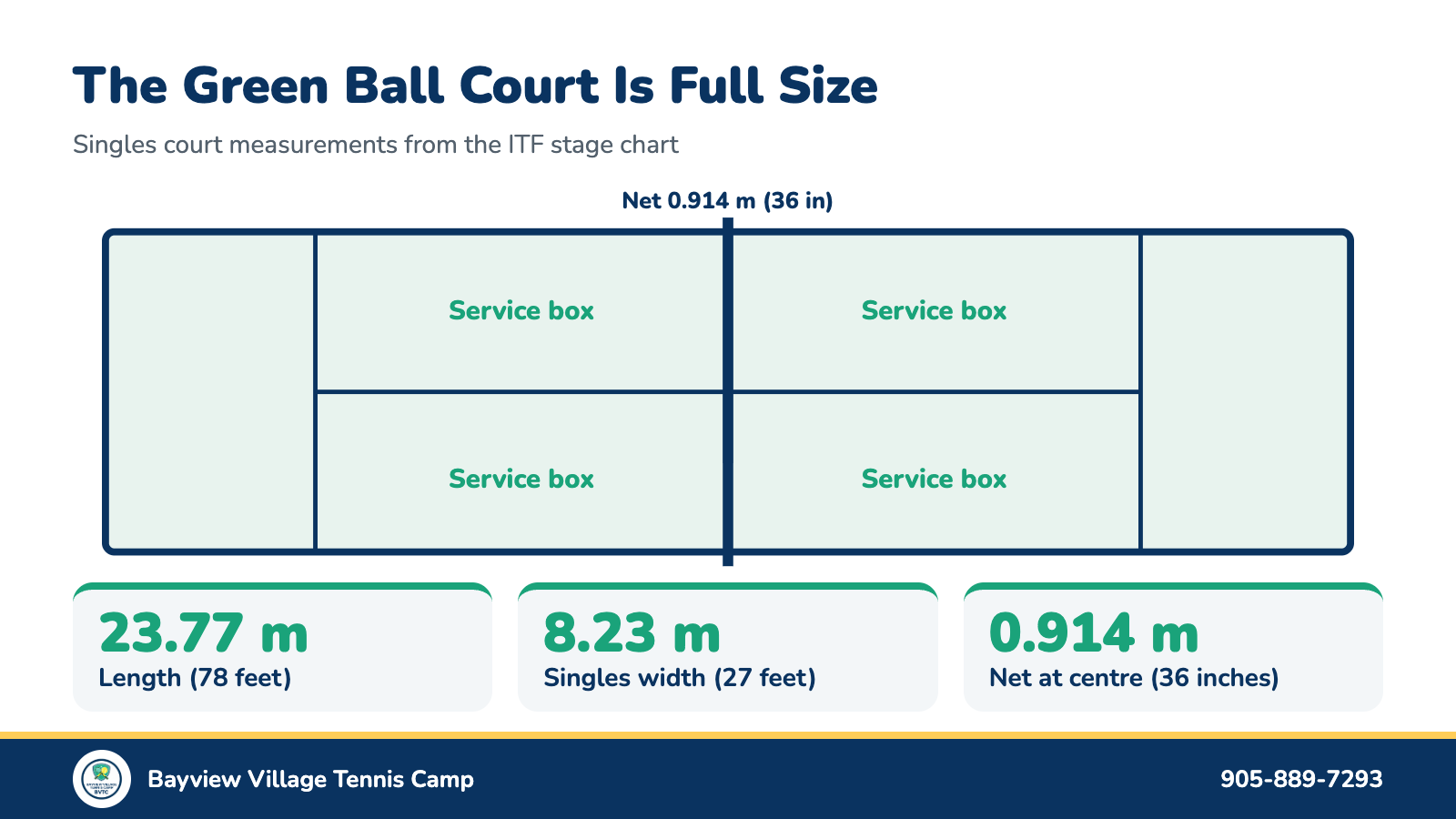
The diagram above shows the singles court used for the green stage, marked with the ITF measurements.
What Are the Green Ball Tennis Rules?
The green ball rules are the standard rules of tennis, with shortened scoring options for young match play. Tennis Canada states that all the basic rules apply. The ITF lists two scoring formats for green. Both formats keep matches short enough for a junior event.
- Best of three tiebreaks to 7 points.
- One short set to 4 games, with a match tiebreak to 10 standing in for a third set.
Serves follow the full rules: the server aims into the diagonal service box and gets a second serve after a fault. Foot faults and lets apply as well. Coaches teach the same line calls and change-of-ends routine that adults follow. For deuce, advantage and tiebreaks, the match scoring guide explains each step.
What Is the Green Ball Tennis Racket Size?
The right racket length for green is 25 to 26 inches (63.5 to 66.0 centimetres) for kids, according to Tennis Canada. The ITF racket chart gives the same 63.5 to 66.0 centimetre range for Stage 1. Teen and adult green players use a 27 inch racket on the Tennis Canada chart.
A racket that is too long slows the swing and spoils timing. Our racket sizing page walks through the right length for each age.
What Is the Difference Between a Tennis Green Ball and a Yellow Ball?
The difference between a tennis green ball and a yellow ball is speed, compression and bounce. Three official sources describe it in three ways. The table lists each source and its wording, so the figures stay with the right body.
| Source | Measure | Green ball against yellow |
|---|---|---|
| ITF | Ball speed (estimated) | About 25% slower |
| Tennis Canada | Compression | About 75% of a yellow ball |
| USTA | Rebound | Slightly lower compression, so it bounces lower |
The ITF talks about speed and Tennis Canada talks about compression. The two percentages measure different qualities, so they should not be compared directly.
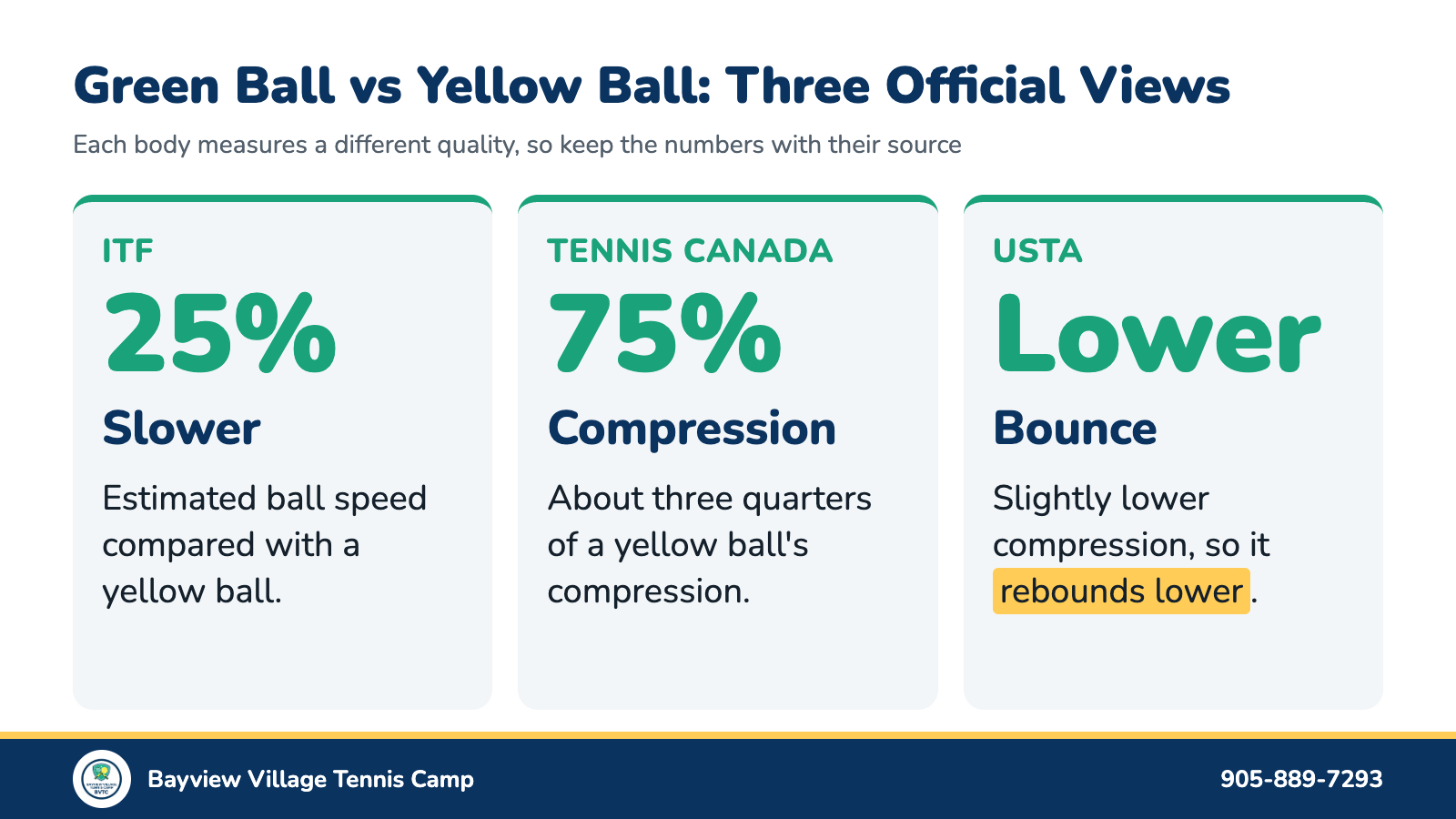
The graphic above repeats the three descriptions side by side. A lower bounce gives a young player more time to set up, which leads to the drills next.
Which Green Dot Ball Tennis Drills Build Rally Skill?
Green dot ball tennis drills build rally skill when they ask players to cover the full court with control. Coaches pick drills that reward consistency before power. Each drill below fits a group lesson on one court.
- Cross-court count: two players rally diagonally and count how many shots stay in play.
- Target cones: players aim at cones near the baseline to practise depth.
- Serve plus one: the server starts the point and plays the first ball after the return.
- Mini-point games: players play to 7 points with the score called out loud.
The same ideas appear on the beginner drills page, set at an easier pace for newer players.
Coaches move players through these drills in order. Early weeks stress getting the ball over the net and into the court. Later weeks add depth, direction and the first point-play games.
When Is a Child Ready to Move From Green Ball to Yellow Ball?
A child is ready to move from green to yellow when movement and shot control hold up in rallies and matches. The ITF treats ages as recommendations tied to the ball. A child moves ball when the game allows it.
The USTA uses a points tracker for under-11 players in the United States. Green players need 1,500 points on that tracker to enter yellow ball events, with at least 1,000 points from wins. That system is American, but it shows how one federation treats readiness.
Our coaches also weigh height, strength and technical ability when they judge a move. Families who want a coach’s view can ask about the junior spring classes and how stage placement works.
Players who stay on green a little longer are not behind. Rushing to yellow before the legs and strokes can handle full-court rallies can cost a player confidence. Waiting a season keeps the game fun and the technique clean.
Competitive pathways start once a player rallies well on yellow. The competition start guide explains when kids can begin to enter events.
Ratings carry on after the colour stages end, and a player keeps moving up the scale. Each step asks for a little more consistency, a little more spin and a little more court sense.
Players who move up keep the habits they built on green. A steady toss, a short backswing and quick recovery all carry over to the yellow ball. The speed rises, and the plan stays the same.
What Else Should You Know About Green Ball Play?
Are There Green Ball Tournaments?
Green ball tournaments exist, and each national association decides its own green events. The ITF guidance says the green ball is allowed at almost every competitive level. Parents should check the event rules with the organizer before entering.
Can Adults Play With Green Balls?
Adults can play with green balls through the teen and adult version that Tennis Canada lists for players rated 1.5 to 2.0. That version uses a 27 inch racket. Adult beginners who want a slower ball can ask about our adult beginner classes.
Can Younger Kids Start on Green Ball?
Younger kids can start on green ball only when their rally skill and movement match the full court. Beginners of any age begin on the stage that fits their current game. Tennis Canada pairs the red stage with kids 8 and under, so young beginners start there.
Does the Green Ball Help Players Reach Yellow Sooner?
The green ball helps players reach yellow by building full-court habits at a calmer speed. A USTA program calls green the final stage before yellow. Players keep the same court, net and rules, so the only change at the move is ball speed. Each player moves at a personal pace.
How Does a Green Ball Bounce?
A green ball bounces lower than a yellow ball because of its slightly lower compression. The USTA describes that lower rebound off the court. The lower bounce gives players time to reach the ball with a full swing.
Frequently Asked Questions About Green Ball Players
What Is an Orange Ball in Tennis?
An orange ball is the Stage 2 ball, one step below green. The ITF rates it about 50% slower than a yellow ball. Tennis Canada lists the kids version for players 9 and under.
What Level Is Red Ball Tennis?
Red ball tennis is Stage 3, the first step on the ladder. The ITF rates the red ball about 75% slower than yellow. Tennis Canada lists the kids version for players 8 and under, on one quarter of a full court.
What Is the Color Code for a Tennis Ball?
The color code runs red, orange, green and then yellow. Red is Stage 3, orange is Stage 2 and green is Stage 1. Yellow is the standard ball used on the full court.
What Color Tennis Ball for a 4 Year Old?
A 4 year old starts with the red ball. A USTA affiliate program lists the red target age as about 4 to 9. Younger children play on a short court with a lower net.
How Bayview Village Tennis Camp Places Players on Ball Stages
Bayview Village Tennis Camp places players on a stage in junior camp, fall and spring programs, private lessons and adult group lessons. Our Tennis Canada certified coaches place each player on the stage that fits the skill level. They move the player up when the game is ready.
Families in North York can ask about extra lesson time for extra work before the move to yellow. A coach can focus on one stroke at a time and build the habits that a faster ball asks for.
Call us at 905-889-7293 to talk about your child’s stage.
Our coaches run every lesson on the Bayview Village courts, and we look forward to seeing your player on court.