
The tie break tennis rules set a 7-point tiebreak for a set and a 10-point tiebreak for a deciding set. Both formats need a two-point margin, according to the International Tennis Federation (ITF) Rules of Tennis. The 7-point game settles a set at six games all. The 10-point game settles a match. The sections below show when each format applies and how each one runs.
Key Takeaways
- A set tiebreak is first to 7 points, and a match tiebreak is first to 10 points.
- Both formats need a lead of two points.
- One player serves point 1, and then each player serves two points in turn.
- Players change ends after every six points.
- The ITF allows a 10-point match tiebreak in place of a deciding set.
- Four Grand Slams have played a 10-point final-set tiebreak at 6-6 since March 2022.
What Are the Tie Break Tennis Rules at Six Games All?
The tie break tennis rules start a tiebreak at six games all. A player wins it with seven points and a lead of two points. The ITF calls this a tie-break game. Players count its points as zero, 1, 2 and 3, not 15, 30 and 40.
Our coaching programs teach this sequence on court, so juniors and adults hear the calls before a real match. Play continues past seven points until one player leads by two. The set then ends 7-6.
Scoreboards show the loser’s tiebreak points in brackets, such as 7-6 (4). That score means the losing player won four points in the tiebreak. The complete scoring guide covers 15, 30 and 40 in a standard game, so this page stays with the tiebreak. The next question is how many points each format needs.
How Many Points Is a Tennis Tiebreaker?
A tennis tiebreaker runs to 7 points in a set and 10 points in a match tiebreak. The ITF sets the 7-point game in Rule 5. It sets the 10-point game in Appendix VI, the section on alternative procedures.
The ITF names both games in its rules, and players use the same counting in each. Players count zero, 1, 2 and 3 in each game. The two formats differ in what they decide. A set tiebreak decides one set. A match tiebreak decides the whole match. Both games end only when the leader holds a margin of two points.
Do You Have to Win by 2 Points in a Tennis Tie Break?
You have to win by 2 points in a tennis tie break, and the margin applies to both games. The ITF text says play continues until a player reaches that margin. A score of 7-6 therefore does not end the tiebreak.
At 7-6 the leader needs one more point. At 7-7 nobody leads, so play goes on. A tiebreak can reach 9-7 or 12-10 before it ends. The margin is the same in both formats, so the choice comes down to the format itself.
Is a Tiebreak to 7 or 10 in Match Play?
A tiebreak is to 7 in a set and to 10 when it replaces a deciding set. The format depends on what the tiebreak decides. The table below lists four formats from the ITF Rules of Tennis.
| Format | Points to win | What it decides | ITF section |
|---|---|---|---|
| Set tiebreak | 7 | One set, at six games all | Rule 5 |
| Match tiebreak | 10 | The match, in place of a deciding set | Appendix VI |
| Final-set tiebreak | 10 | The match, at six games all in the final set | Appendix VI |
| Short-set tiebreak | 5 | A short set, at four games all | Appendix VI |
The 7-point and 10-point formats both require a two-point margin. The graphic below places those two main formats side by side.
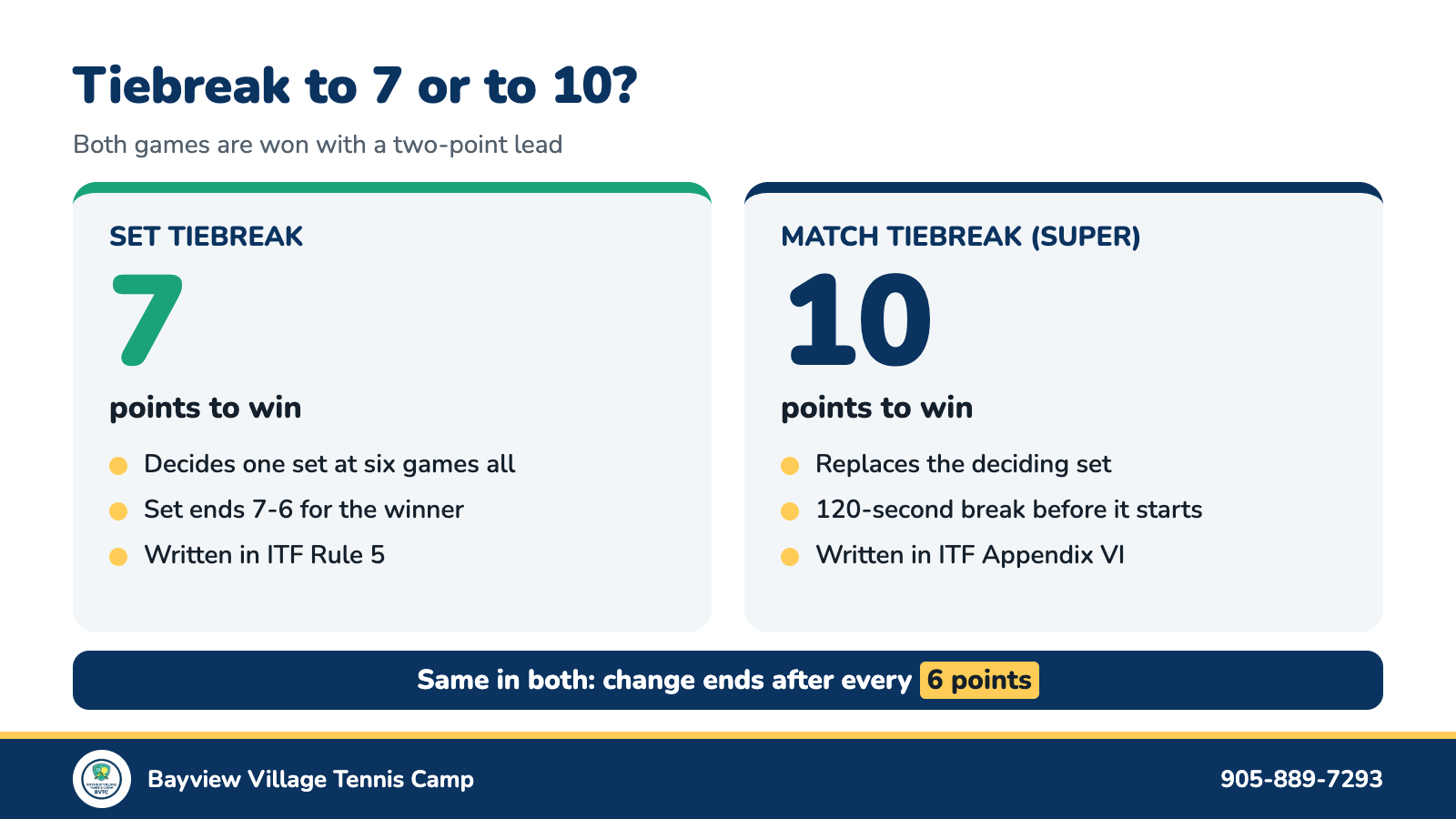
Event rules decide which format a match uses, because the ITF text says a match tiebreak may be played. Families planning tournaments can read the draw sheet for the format first. The 10-point format has its own name, which is the next topic.
What Is a Super Tiebreak in Tennis?
A super tiebreak in tennis is a 10-point match tiebreak that replaces the deciding set. The first player to reach ten points with a two-point lead wins the match. The ITF allows it when a match reaches one set all. In a best-of-five match, it applies at two sets all.
Four details set a super tiebreak apart from a set tiebreak.
- Players take a 120-second break before it starts.
- The original order of service continues.
- Doubles teams may change the order of serving and receiving within the team.
- Players do not change balls before it starts, even when a ball change is due.
When an event uses it, a match at one set all goes to the super tiebreak after the 120-second break. It can end 10-7 or 12-10, since the two-point margin still applies.
These details come from Appendix VI of the ITF Rules of Tennis. They explain why a match tiebreak plays like a short final set. Its history shows why the 10-point format is now familiar.
When Did Tie Break Change to 10?
Tie break scoring changed to 10 points in the final set at the four Grand Slams in March 2022. The Australian Open had used the 10-point format since 2019, says the United States Tennis Association (USTA). The other three majors then adopted it for a deciding set at 6-6.
A 10-point match tiebreak replaced the third set in mixed doubles earlier, according to published tennis histories. The Australian Open adopted it in 2001. The US Open followed in 2003, and the French Open followed in 2007.
The 7-point game is older. James Van Alen unveiled the tiebreak in 1965 as an experiment at a pro tournament he sponsored. The US Open used a nine-point version in 1970 and moved to seven points in 1975. The mechanics of the game come next.
How Does a Tiebreaker Work in Tennis?
A tiebreaker works as a short game with its own serving pattern, its own end changes and a two-point margin. Six steps carry a tiebreak from first point to last. The numbered list follows the ITF Rules of Tennis.
- Start the tiebreak when a tie-break set reaches six games all.
- Serve the first point from the right half of the court.
- Let the opponent serve the next two points.
- Alternate after that, with each player serving two points in a row.
- Change ends after every six points.
- End the game when one player reaches the target with a two-point lead.
The steps apply to the 7-point and 10-point games, and only the target changes. A short example shows the flow. After point 6, players change ends. Player B served point 6 and then serves point 7 from the right half of the court.
That example shows why a tiebreak feels fast. Each player holds the serve for only two points at a time. The two sections below take the serving pattern and the end changes in turn.
What Is the Tennis Tiebreak Serving Order?
The tennis tiebreak serving order gives one point to the first server and then two points to each player in turn. Player A serves point 1, and Player B serves points 2 and 3. Player A then serves points 4 and 5. Each serve comes from alternate halves of the court, starting from the right.
The graphic below maps the first 12 points. It marks the server, the court half and the end change after point 6.
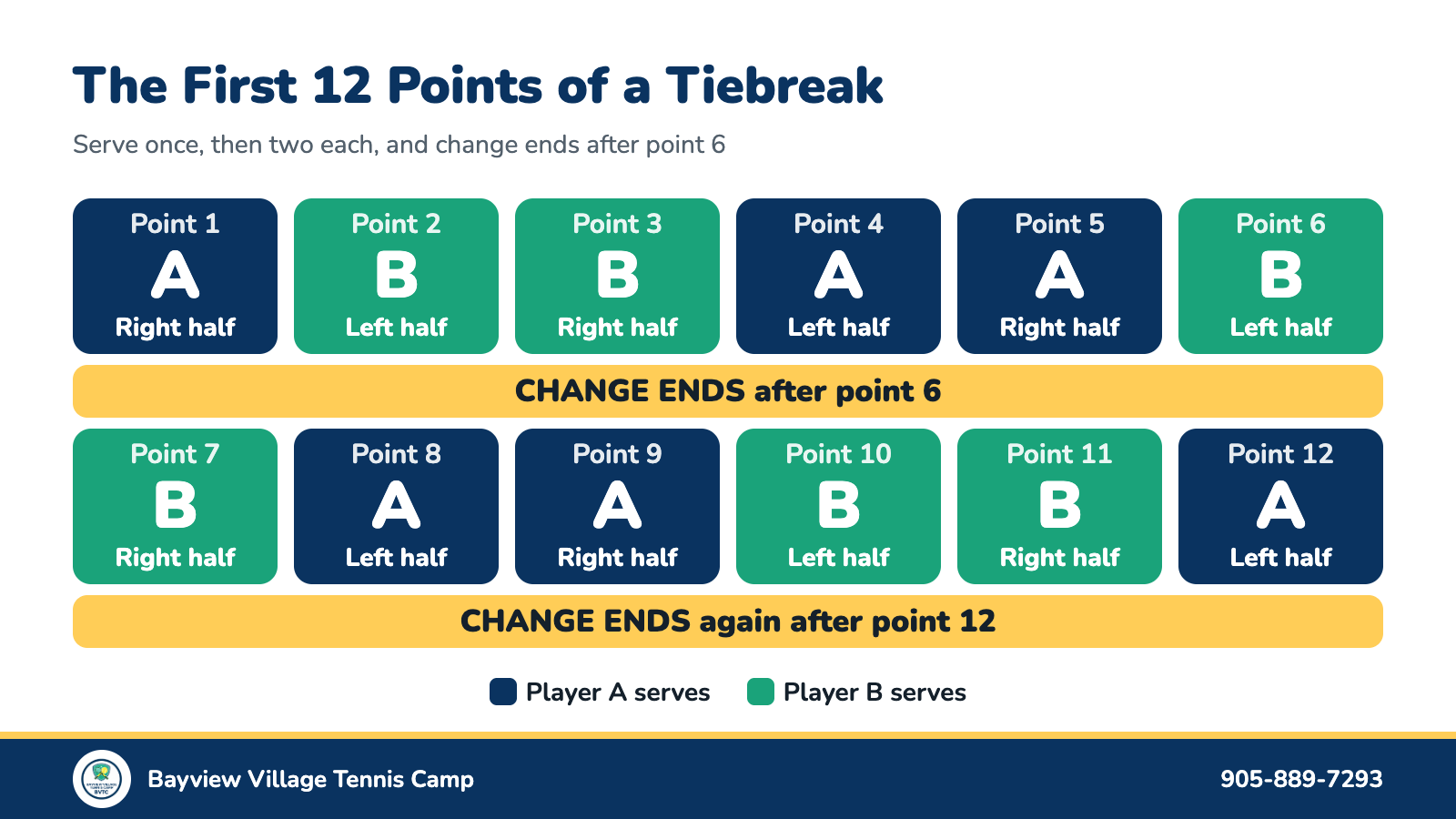
The pattern repeats for the whole game. The only break in it is the change of ends.
When Does the Tennis Tiebreak Switch Sides?
The tennis tiebreak switch sides rule is simple, because players change ends after every six points. The first change comes after point 6. The next comes after point 12.
A standard game uses a different rule, since players change ends after the first, third and every later odd game. The six-point rule belongs to the tiebreak alone. Doubles teams add one more layer to the serving pattern.
What Are the Tennis Doubles Super Tie Break Rules?
The tennis doubles super tie break rules use the same first-to-10 game as singles. Each team keeps its service rotation, says the ITF. The player due to serve takes point 1, and a player from the opposing team serves the next two points.
A short example shows the rotation. Player A1 serves point 1. Player B1, who is due to serve next, serves points 2 and 3. Player A2 then serves points 4 and 5, and Player B2 serves points 6 and 7. The cycle then returns to A1.
After that, each side serves two points in a row. The rotation within each team continues in the same order as during the set. For a match tiebreak, the ITF lets a team change its order of serving and receiving. That change matches the one allowed at the start of a set.
Mixed doubles players meet this format at major events, as the history above shows. Our post on mixed doubles covers how partners share the court. Junior formats add a shorter option.
Which Tennis Tiebreak Rules Apply in Junior Matches?
The tennis tiebreak rules in junior matches come from the event, which picks from the formats in the ITF Rules of Tennis. The ITF also lists a short set, where players race to four games. The tiebreak starts at four games all.
A short-set tiebreak changes ends only after the first four points. Parents can find the format in the event rules before the first match. Our competitive tennis post explains when juniors begin to enter events.
Young beginners meet the same choice. The ITF Tennis10s program is for players aged 10 and under. It lists one tiebreak to 7 or 10 as a Red ball scoring option. Red ball matches use a smaller court and slower balls.
Parents can check three details in the event rules before a tournament.
- The set type, which is either an advantage set or a tie-break set.
- Whether a 10-point match tiebreak replaces the deciding set.
- Whether the event plays short sets with a tiebreak at four games all.
Adult club and league matches may use the same 10-point format, since the ITF allows it in place of a deciding set. Players in our weekly programs practise tiebreak points in drills. That habit makes the first real tiebreak feel familiar.
How Can Players Practise Tiebreak Points?
Players practise tiebreak points by playing short games that copy the real serving pattern and the real target. Four drills build the habit, and coaches can run each one in a normal practice.
- Play a full first-to-7 game from 0-0, with the serve pattern of one point and then two.
- Start at 5-5 and play until one player leads by two points.
- Play a first-to-10 game after a short rest, to copy the match tiebreak.
- Change ends after point 6, so the switch becomes automatic.
Pressure is the hard part of any tiebreak, because every point carries weight. Our post on match pressure offers routines that players can use between points. The side questions below cover the rules that players ask about next.
What Else Should You Know About Tiebreak Rules?
What Is 6-6 Called in Tennis?
6-6 is called six games all, and it starts a tiebreak in a tie-break set. The ITF uses the words six games all. The score is different from 40-40 in a game, which players call deuce. The post on love and deuce explains that call.
What Does 7-7 Mean in Tennis?
A score of 7-7 in a tiebreak means both players have won seven points. Nobody leads, so play continues until one player has a two-point lead. In an advantage set, 7-7 in games has the same effect.
Do All Sets Have a Tiebreak?
No, not all sets have a tiebreak, because an advantage set continues until a player leads by two games. The event announces the set type in advance. A tie-break set plays the tiebreak game at six games all.
Does a Tiebreak Count as a Game?
A tiebreak counts as one game, and the winner takes the set 7-6. The ITF text says the winner takes the game and the set. The tiebreak also counts as one game for the ball change.
Who Serves First in the Next Set?
The player who served first in the tiebreak receives first in the next set. The tiebreak therefore passes the serve to the other player. The USTA and the ITF state this rule in the same way.
Frequently Asked Questions About Tiebreak Rules
What Are the New Tie Break Rules?
The 2026 ITF Rules of Tennis list the 10-point match tiebreak and the 10-point final-set tiebreak as alternative procedures. Four Grand Slams have played a 10-point tiebreak at 6-6 in the final set since March 2022. A 120-second break comes before a match tiebreak.
Can You Get Aces in a Tiebreaker?
Yes, a player can hit an ace in a tiebreaker, and it counts as one point like any other. The serve still passes over the net into the diagonal service box. The server uses alternate halves of the court.
Do Players Change Balls at the Start of a Tiebreak?
No, the rules do not allow a ball change at the start of a tiebreak game. The ITF counts a tiebreak as one game for ball changes. A match tiebreak also starts without a ball change, even when one is due.
How Bayview Village Tennis Camp Practises Tiebreaks
Bayview Village Tennis Camp practises tiebreaks with juniors and adults, led by Tennis Canada certified coaches. Families can choose memberships, private lessons and adult group lessons, or a junior summer camp with fall and spring junior programs. Our coaches practise scoring, including tiebreak points, in drills so players meet the pressure before a match.
Juniors who want weekly play can join junior fall sessions in the autumn. Coaches run short games that copy the serving pattern. Players learn the end changes by doing them, not by memorizing a chart.
Adults can choose adult classes for doubles and match play. Doubles groups practise the service rotation inside a team. That rotation is the part of a super tiebreak that players should see on court before they play one.
Families can reach BVTC tennis to ask about groups at our North York courts. We match each player to a level and a format that fits.
Call us at 905-889-7293 to book a place.