The penalty for a foot fault in tennis is a service fault, and two service faults in a row lose the point. The International Tennis Federation (ITF) Rules of Tennis list four foot fault actions in Rule 18. The server then hits a second serve from the same side of the court. A second fault on that point ends it, whatever the age or level of the player.
Key Takeaways
- A foot fault is a service fault, so the server gets one more serve on that point.
- Two consecutive faults of any kind lose the point for the server.
- Rule 18 lists four foot fault actions, and each one happens during the service motion.
- Officials make the call when they work a match, and players make it when no official is present.
- A calm start behind the baseline and a marker on the court help a server avoid the fault.
What Is a Foot Fault in Tennis?
A foot fault in tennis is a serving error where the server’s feet break a position rule during the service motion. The ITF Rules of Tennis 2026 describe it in Rule 18. The rule applies from the start of the motion until the racket hits or misses the ball.
Before that motion starts, Rule 16 asks the server to stand at rest behind the baseline. Both feet must also sit inside the imaginary extensions of the centre mark and the sideline. Our lesson programs teach this starting position on day one, because every later serve builds on it.
A foot fault is easy to commit and easy to miss, so the penalty is the next thing to learn.
What Is the Penalty for a Foot Fault in Tennis?
The penalty for a foot fault in tennis is a service fault, exactly like a serve that lands out. Rule 19 says a serve is a fault when the server breaks Rule 16, 17 or 18. The ball may land perfectly in the box, and the serve still does not count.
The penalty for foot fault in tennis follows a short sequence on court. Each step comes straight from the ITF Rules of Tennis 2026.
- The server’s foot breaks Rule 18 during the service motion.
- The serve counts as a fault under Rule 19.
- The server serves again from behind the same half of the court under Rule 20.
- A second consecutive fault loses the point under Rule 24.
The graphic below shows the same four steps as a flow from the first fault to the lost point.
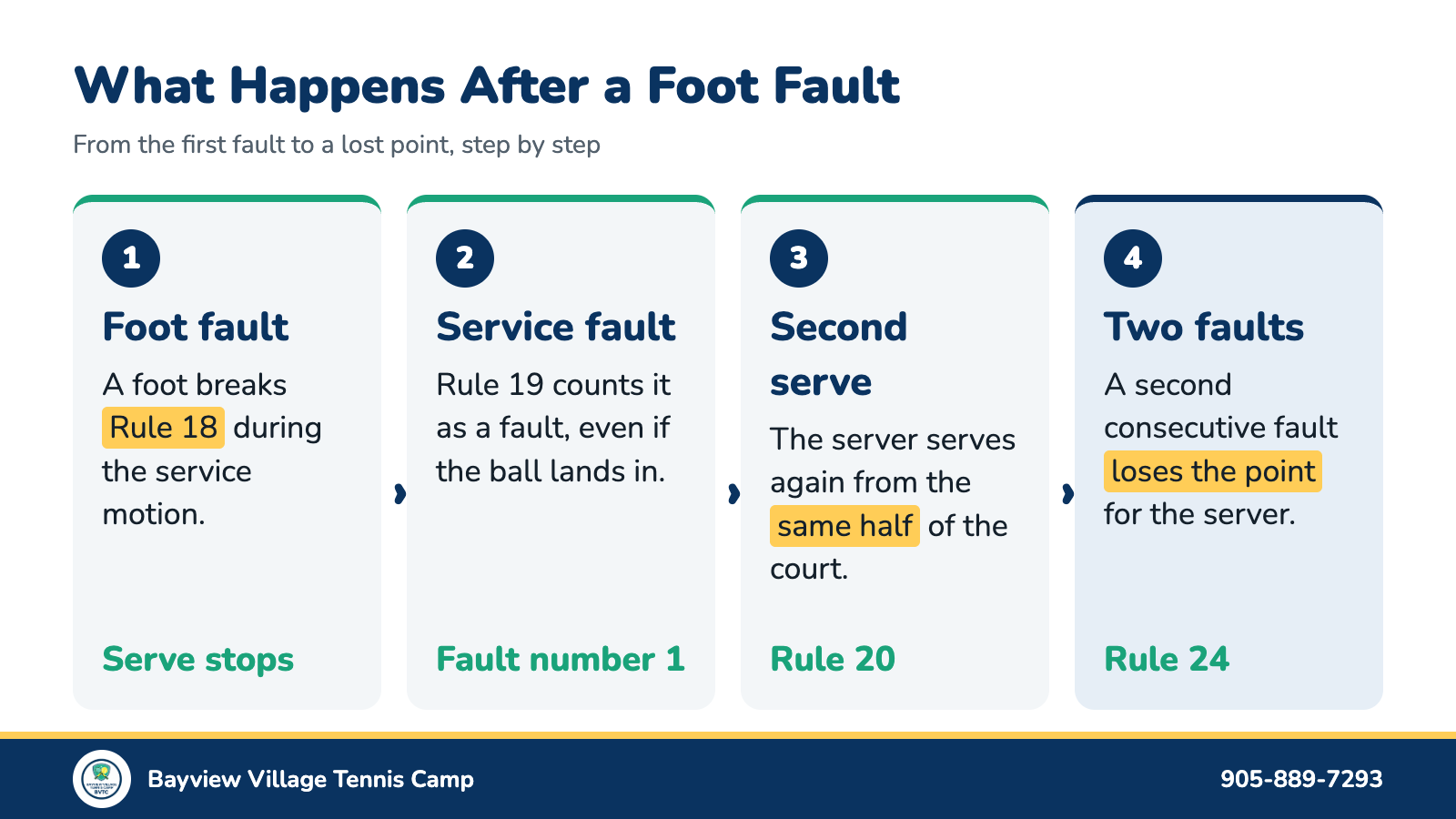
The flow shows that one foot fault costs a serve, not a point. That difference leads to the question of what happens next.
What Happens With a Foot Fault?
A foot fault on a first serve leads to a second serve from the same side of the court. The server serves again without delay. The score does not change until the point ends.
The second serve carries more pressure, because any further fault loses the point. That includes a second foot fault. Juniors feel this in match play, where one rushed step can turn a first serve into a lost point.
A foot fault on a second serve ends the point at once. The receiver wins it, and the next point starts as normal. Players can use this clear outcome to understand the rule itself, which the next section sets out.
What Are the Foot Fault Tennis Rules in Rule 18?
The foot fault tennis rules in Rule 18 list four actions that a server must avoid during the service motion. The wording is short, and the table below puts each action in plain terms.
| Action | What it means | Where it happens |
|---|---|---|
| Walking or running | The server changes position, although slight foot movements are allowed | Anywhere behind the baseline |
| Touching the baseline or court | Either foot lands on the line or inside the court | Along the baseline |
| Crossing the sideline extension | Either foot touches the area outside the imaginary sideline extension | Wide of the court |
| Touching the centre mark extension | Either foot touches the imaginary extension of the centre mark | Middle of the baseline |
Slight movements of the feet are allowed under Rule 18, so a small shuffle is not a fault. A walk or a run is a fault. The ITF also confirms that a server may have one or both feet off the ground.
The picture below puts all four actions on one card for quick study. Parents who want the wider picture can pair it with the summary of the rule basics alongside it.
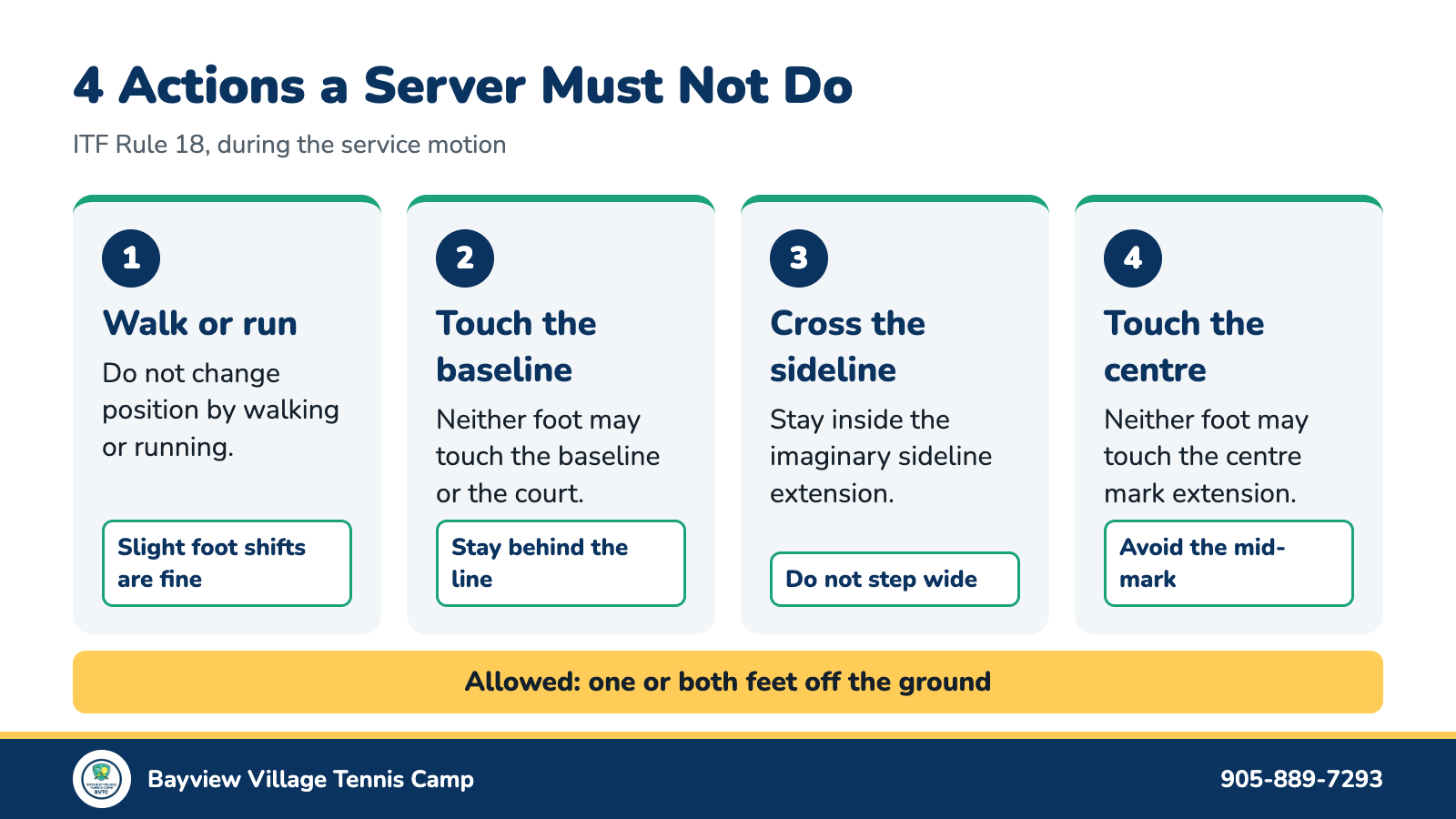
Knowing the four actions makes it easier to see how a foot fault happens.
What Causes a Foot Fault in Tennis?
What causes a foot fault in tennis is a foot landing in a forbidden spot during the service motion. Each of the four actions in Rule 18 matches one cause. The list below maps each cause to its rule.
- A server steps on or over the baseline while swinging forward.
- A server walks or runs into the serve, which changes position.
- A server drifts toward the centre mark and touches its imaginary extension.
- A server drifts wide and touches the area outside the sideline extension.
Rushing links all four causes, and slowing down is the simplest fix. A relaxed set-up gives the feet time to settle before the toss. Players can also learn the court diagram to know exactly where the baseline, centre mark and sidelines sit.
Once a player understands the causes, the next question is who spots them in a match.
Who Can Call a Foot Fault in Tennis?
A chair umpire, a referee or a line judge can call a foot fault in tennis when they work the match. Officials hold that role at tournaments, where someone watches the server’s feet. The call comes right away, and the serve counts as a fault.
Club matches, school matches and casual games have no officials. Players make the calls there, and the receiver stands in position to see the server’s feet. We teach juniors that the call is about fairness, not about winning an argument.
A player in that spot may want the next answer.
Can You Call a Foot Fault on Your Opponent?
You can call a foot fault on your opponent in a match that has no official, but a friendly warning comes first. A foot fault counts the same as any other fault. The receiver should be sure of what happened before speaking up.
A short and polite message works well, such as telling the server that a foot touched the baseline. The server can then adjust the next serve. Our guide to on-court conduct covers more of these friendly habits.
A calm tone keeps the match friendly, which matters in junior and club play. Raising the concern once, then moving on, protects the rhythm of the match. The next comparison clears up a common mix-up between two kinds of fault.
Is a Foot Fault the Same as a Double Fault?
A foot fault is not the same as a double fault. A foot fault is one fault, and a double fault is two in a row. Rule 24 says a player who serves two consecutive faults loses the point. The table sets the three terms side by side.
| Term | What it is | Result |
|---|---|---|
| Foot fault | One service fault caused by the server’s feet | Server hits a second serve |
| Service fault | Any serve that breaks Rule 16, 17 or 18, or misses the ball | Server hits a second serve |
| Double fault | Two consecutive faults on one point | Server loses the point |
A foot fault can be one half of a double fault. A foot fault on the first serve plus a long second serve gives a double fault. Our lesson on serving errors covers the other serve errors.
Prevention is the real goal, so the next section turns to practice.
How to Avoid Foot Fault in Tennis
To avoid foot fault in tennis, start every serve from the same spot, a small step behind the baseline. A fixed spot gives the feet a clear target. The routine below suits juniors and adults.
- Lay a spare racket or a cone along the baseline as a visual marker.
- Stand at rest behind the marker, inside the centre mark and sideline extensions.
- Take a breath, then check that both feet sit behind the line.
- Serve at a steady pace and hold the stance until the toss.
- Look down after the serve to see where the feet landed.
A spare racket on the line gives instant feedback without a coach nearby. A filmed serve from the side shows the feet clearly. Players can replay it and compare where each foot started and landed.
Balanced feet help the server stay behind the line, so good foot movement supports every serve. The routine builds a habit before match pressure arrives. A coach can then add small cues, such as a quiet breath before the toss.
The full serve motion is a separate skill, and a coach teaches it in steps. Stance, toss and swing are not part of Rule 18. A player who masters the start position has solved the part of the serve that Rule 18 covers.
Why Does Tennis Have a Foot Fault Rule?
Tennis has a foot fault rule so that every server starts from behind the same line. A server who steps into the court shortens the distance to the net. The rule keeps that distance fair for both players.
The rule also keeps the service motion consistent. Rule 16 fixes the start position, and Rule 18 limits movement during the swing. Together they give the receiver a clear picture of where the serve begins.
Fair rules help young players too, because the same limits apply to every junior in the draw. Parents can use this idea when a child feels upset about a call.
How Should Parents Talk to Juniors About Foot Fault Calls?
Parents should treat a foot fault call as feedback on the serve, not as a judgment on the player. A child who hears a call may feel embarrassed in front of friends. A calm reply, such as thanking the opponent, models good sportsmanship.
After the match, a parent can ask the junior to show where the feet start. A short drill with a marker on the baseline turns the call into a task. Families can find a wider guide in the post on junior tennis for parents.
Calm practice beats frustration, and the habit grows with repetition. Coaches can also set a simple goal, such as a run of serves with clean feet. A goal like this gives a junior a win to chase.
Is There a Tennis Foot Fault Rule Change in 2026?
The 2026 ITF Rules of Tennis state the foot fault rule in Rule 18, and our coaches follow that text. Rule 18 lists four prohibited actions during the service motion. Anyone who asks what is a foot fault in tennis should start with that rule. A question about a tennis foot fault rule change should lead to the edition used at the event.
Rule 16 also fixes the moment the service motion ends, which is when the racket hits or misses the ball. Foot position after that moment does not matter for a foot fault. Event organizers adopt the ITF text, so the same wording guides matches at every level.
What Else Should You Know About Foot Faults?
Do They Still Call Foot Faults in Tennis?
Yes, officials still call foot faults in tennis, because Rule 18 remains part of the ITF Rules of Tennis 2026. Players in friendly games should know the rule even when nobody enforces it. Knowing it early prevents a bad habit from forming.
Why Do They Yell Fault in Tennis?
Officials call “fault” aloud to tell both players the serve is not good. The call applies to a foot fault, a serve into the net and a serve that lands out. The server then moves on to the second serve.
Can a Server Jump During the Serve?
A server can jump during the serve, because ITF Rule 18 confirms that one or both feet may be off the ground. The fault happens when a foot touches the baseline or the court during the motion. Landing inside the court after the racket hits the ball is not a foot fault, since the motion has ended.
Can Doubles Servers Stand Wider?
Doubles servers can stand between the singles sideline and the doubles sideline, according to ITF Rule 18 Case 1. A singles server cannot stand there. The centre mark extension still applies in both formats.
Frequently Asked Questions About Foot Faults
What Is the Rule for Foot Fault in Tennis?
Rule 18 says the server must not walk or run, or touch the baseline, the court or the centre mark extension. The server must also stay inside the sideline extension. These limits apply during the service motion, and a break of the rule is a foot fault.
How Many Faults Are There in Tennis?
A server may hit one fault per point and still get a second serve. A second consecutive fault loses the point. Foot faults, long serves and net serves all count toward that total.
What Is a Service Fault in Tennis?
A service fault is a serve that breaks Rule 16, 17 or 18, misses the ball, or hits a permanent fixture first. The ball must also clear the net and land in the diagonally opposite service court. Any of these breaks makes the serve a fault.
Does a Foot Fault Matter in Junior Tennis?
A foot fault matters in junior tennis because the same Rule 18 applies once a player enters matches with officials. Learning a clean start early avoids a bad habit later. Coaches build this routine long before the first tournament.
How Bayview Village Tennis Camp Coaches Foot Position
Bayview Village Tennis Camp coaches foot position in every serve lesson, using Tennis Canada certified coaches in North York. Juniors learn the starting spot in junior camp lessons, with simple cues and a clear marker to practise with. Each player leaves with a routine to repeat at home. The marker on the line also gives parents a simple way to check progress between sessions.
The adult class sessions build the same habits for grown-up players. A coach watches the serve from the side and gives quick feedback on the feet. A short drill at the start of each session keeps the routine fresh.
Some players want a closer look at their own serve routine. Our individual lessons lets a coach review the feet, the toss and the finish in one session. The coach then sets one clear goal for the next week, and the player practises it on court.
Families can compare season choices to find a fit for the season, from summer camp to the fall and spring junior programs. Each option teaches the rules next to the strokes, so players learn about foot faults before a match begins.
Players are welcome to train on our home courts, where the baseline and centre mark make a clear practice reference.
Call 905-889-7293 to talk with the team about lessons, camps and serve coaching.