A rally is a whole exchange of shots, and a volley is one shot hit before the ball bounces. Every volley sits inside a rally, but a rally also holds groundstrokes hit after one bounce. A volley is usually hit near the net, and the service line sits 6.40 metres (21 feet) from it. That position cuts your opponent’s reaction time. Juniors and club players can learn how the two ideas fit together.
Key Takeaways
- A rally is the full series of return hits after a serve, and a volley is a single shot inside it.
- A volley is struck in the air, while a groundstroke is struck after one bounce.
- The four main volley types are the punch, the block, the drop and the drive.
- A half volley meets the ball right after it lands, so coaches treat it as a separate shot.
- Smaller red and orange courts help children rally from the first lesson and reach the net sooner.
What Is a Volley in Tennis and Where Does a Rally Fit?
A volley in tennis is a shot you hit out of the air before the ball bounces on your side. A rally is different because it is the whole sequence of shots that follows a serve. A rally ends when one player fails to return the ball in court.
A volley is one shot type, while a rally is a stretch of play. Our coaches show both ideas in one-on-one coaching, so a player sees where a volley lives inside a rally. The next section looks closer at the rally itself.
What Is a Rally in Tennis?
A rally in tennis is the series of return hits that starts after the serve and stops when a player misses. The rally ends with a ball that lands outside the boundary or a ball that goes unreturned. A rally can hold two shots or a long run of shots, from the first serve return to the final miss. A coach counts every hit as part of one rally.
Baseline rallies lean on groundstrokes. A groundstroke is a forehand or backhand hit after the ball bounces once. A volley skips that bounce, which is why it feels faster. The comparison below puts the two ideas in one place.
How Do a Rally and a Volley Compare Side by Side?
A rally and a volley differ first in size, since a rally is a sequence and a volley is a single shot. The table lists the four differences that matter most to a new player. Read it row by row, then look at the picture that follows.
| Feature | Rally | Volley |
|---|---|---|
| What it is | A series of return hits after the serve | One shot hit before the bounce |
| Bounce rule | Mixes groundstrokes and volleys | No bounce on your side |
| Typical position | Baseline or net | Close to the net, inside the service line |
| Swing | Full swing on groundstrokes | Short backswing and a punching stroke |
The table shows that a volley is one ingredient of a rally. The graphic below draws the same contrast for juniors and parents.
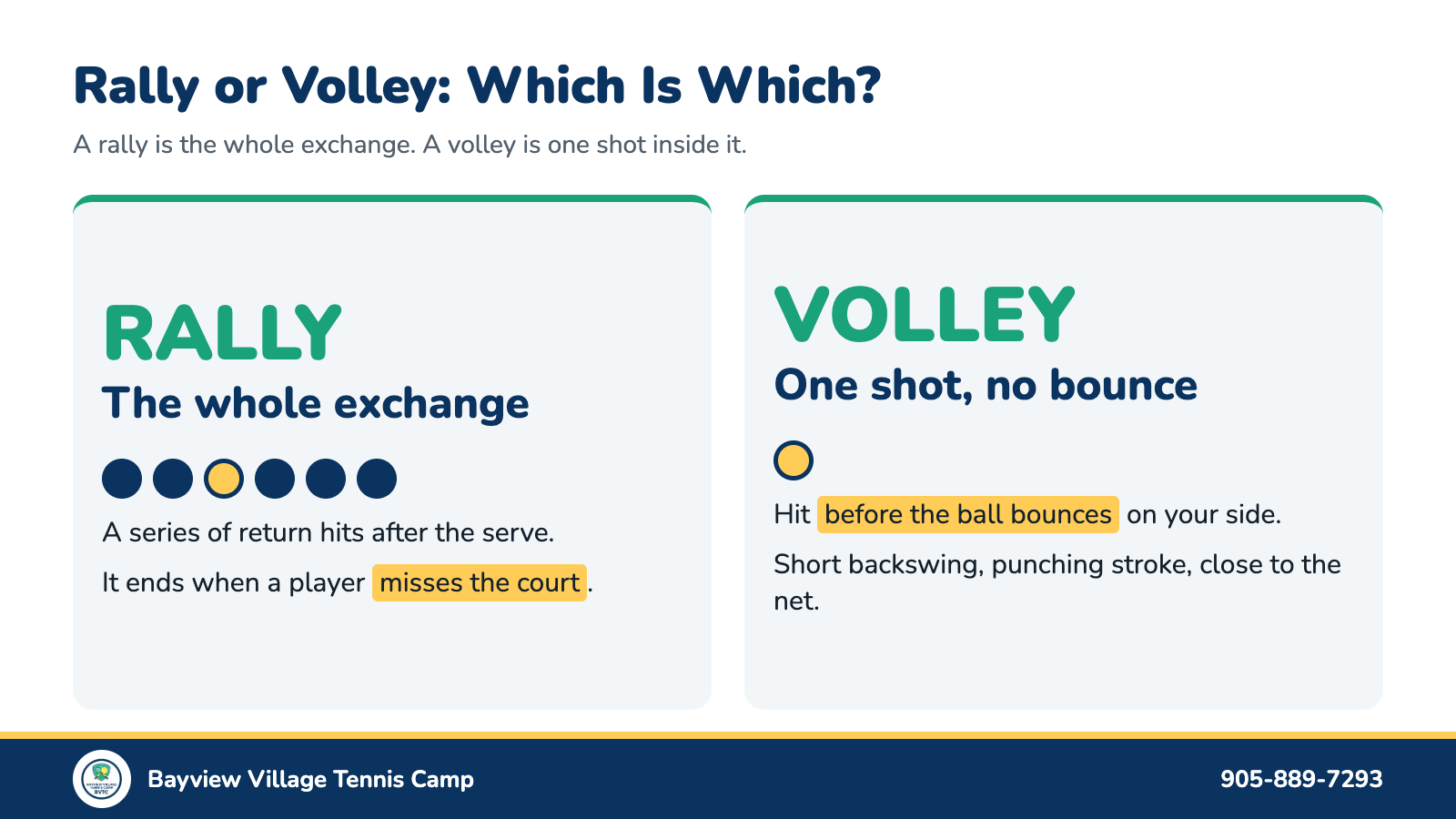
A volley also takes away the chance of a bad bounce on an uneven court. A rally cannot offer that, since groundstrokes bounce first.
Why Does a Volley Matter Inside a Rally?
A volley matters inside a rally because it moves the player onto the attack and shortens the opponent’s reaction time. The list below gives four aims of the shot.
- The volley takes the offensive and cuts the time the opponent has to react.
- The shot removes any chance of a bad bounce on uneven grass or clay.
- A player near the net has a wider choice of angles into the opponent’s court.
- The shot asks for quick reflexes and strong hand-eye coordination.
The passing shot and the lob are the two main answers to a volley. A volley has three safe targets. One is a drop volley that barely clears the net. Another is a sharply angled shot. The third is a hard shot that lands near the baseline and sideline. Any other volley gives the opponent time for an aggressive reply.
That advice shows why placement matters as much as timing. A junior who understands it stops treating the volley as a swat and starts treating it as a choice. The next section explains the word itself.
What Does Volley Mean in Tennis and Why Is It Called a Volley?
Volley in tennis means a shot struck before the ball bounces. The tennis volley meaning is therefore a ball hit while it is still flying. That timing rule never changes.
Coaches group every stroke by contact time: serve, groundstroke, volley or half volley. That grouping answers most beginner questions about names. A ball hit in the air is a volley, and a ball hit after one bounce is a groundstroke.
Coaches use the name as a quick timing check. A player who says “volley” is telling a partner that no bounce will happen. The next section covers the shapes a volley can take.
What Are the Types of Volleys in Tennis?
The types of volleys in tennis are the punch, the block, the drop and the drive. The choice follows the speed and height of the incoming ball. Coaches add the overhead smash as a related shot. We group the four as the core tennis volley types.
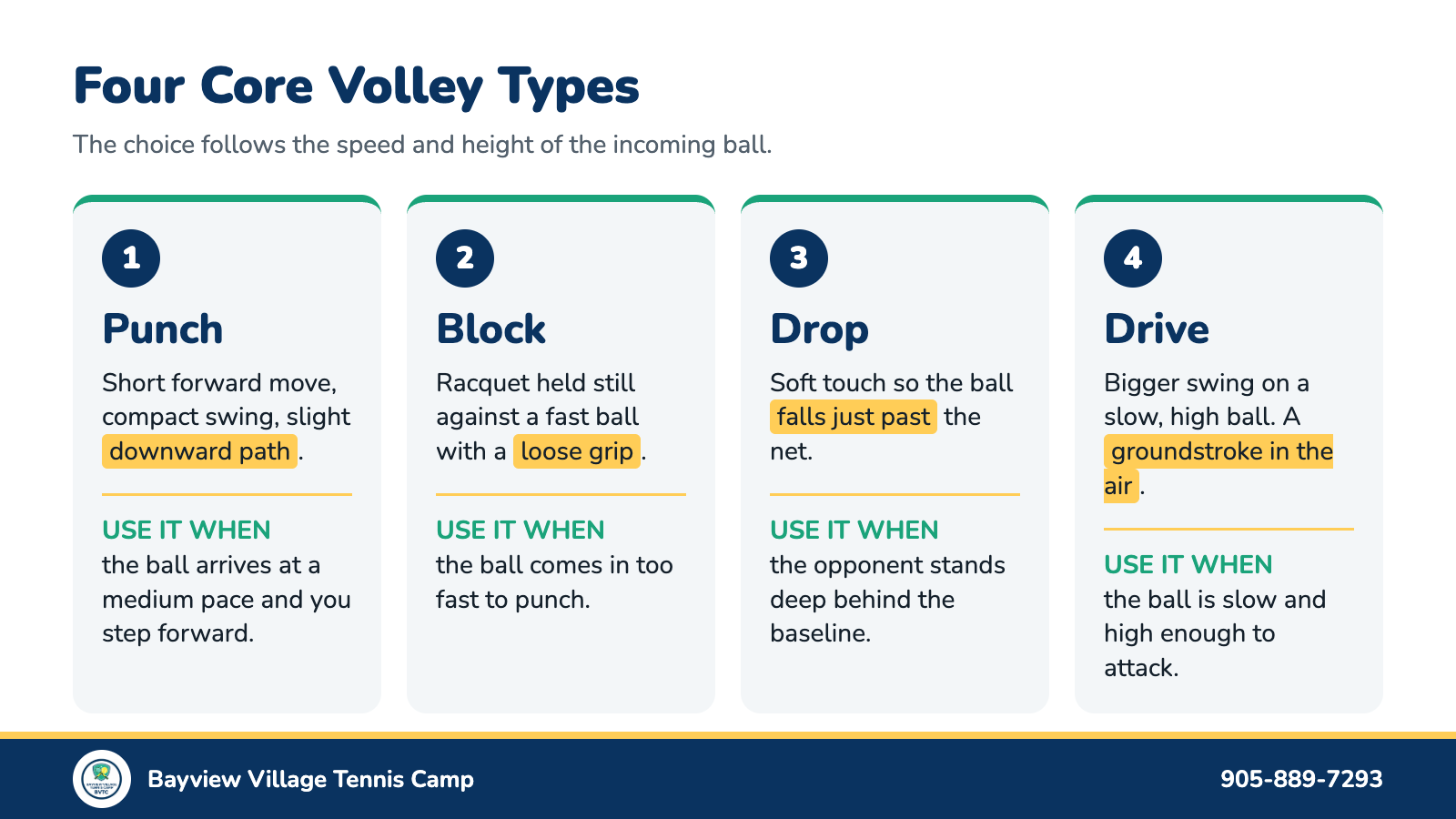
The graphic above gives one cue for each type. The list below adds the contact details a junior player can feel.
- The punch volley uses a short forward movement and a compact swing, with a slight downward racquet path.
- The block volley holds the racquet still against a fast ball and relies on a loose grip.
- The drop volley touches the ball gently so that it falls just beyond the net.
- The drive volley uses a bigger swing on a slow, high ball and looks like a groundstroke in the air.
A drive volley is also called a swing volley, and the two names mean the same shot. A lob volley is a related shot that aims over an opponent standing near the net.
What Is a Drive Volley?
A drive volley is a volley hit with a full backswing and follow-through, giving the ball topspin or backspin. It is the volley version of a groundstroke. It suits a slow ball that gives the player time to swing.
What Is a Backhand Volley in Tennis?
A backhand volley in tennis uses the non-dominant side of the body. The search term what is backhand volley in tennis names this single shot. Coaches find it harder than the forehand volley, with a shorter and fluid movement. Players hold the same continental grip for both sides, which is covered in volley grip basics.
How Does a Tennis High Volley Work?
A tennis high volley is a volley taken when the ball arrives high, with the arms extended and the racquet head forward. The player prepares in advance and strikes firmly so that the opponent cannot counter-attack.
Is It Still a Volley If the Ball Has Bounced?
No, a shot hit after the ball has bounced is not a volley. A volley needs a ball that is still in the air. A half volley is a groundstroke hit immediately after the bounce, which keeps it outside the volley family.
A half volley contacts the ball close to the ground while it rises from the bounce. That timing makes it harder than a volley. Our coaches teach it as its own skill, so a short mention is enough here before the next section.
What Is Serve and Volley in Tennis?
Serve and volley in tennis is a style where the server runs to the net after serving. The server then hits a volley. It is a plan to end points fast and put pressure on the opponent. It makes the rally short.
The style suits fast courts better than slow courts such as clay. Modern racquets and strings let baseliners create spin on passing shots, which makes net play harder. Juniors still learn the idea. Every player meets a short ball at some point, and approaching the net is the first step.
How Does a Rally Turn Into a Volley Point?
A rally turns into a volley point when a player moves forward and meets a slow or high ball in the air. A net visit is a way to close a point fast. The four steps below show the usual order.
- One player hits a strong approach shot or a firm serve that pushes the opponent back.
- The opponent replies with a slow or high ball that stays in the air.
- The net player takes a split step, which UTR Sports calls the foundation of every volley.
- The net player volleys into open court or drops the ball short.
A very high ball calls for an overhead smash instead of a volley. Each step uses a skill that juniors can practise on their own. Footwork builds the split step, the grip builds the contact, and placement builds the finish. A coach can break the four steps into drills, and the section on doubles shows why they matter so early.
When Can You Volley in Tennis?
You can volley in tennis whenever the ball is in the air on your side of the net and has not bounced. Three moments suit a volley. They are after a serve-volley, after a strong approach shot, and after a high or slow ball from the opponent.
Doubles gives extra chances. Doubles has more volleys because one partner stands at the net. A player in that spot takes balls before the bounce all match. Pairs who like that role can study the doubles guide on our site for court positions.
The body volley is a related case. A ball aimed at the player’s body in doubles is a volley that needs a quick reaction and a steady stance.
How Do Rallies and Volleys Fit Into Junior Lessons?
Rallies and volleys fit into junior lessons in two steps. Children first learn to keep a rally going, then add volleys at the net. The International Tennis Federation (ITF) Play and Stay programme supports the first step with smaller courts. Those courts give children time and control from the first lesson.
The ITF orange court is 18 metres (59 feet) long and 6.4 metres (21 feet) wide for players aged 10 and under. The red court is 11 metres (36 feet) long and 5.5 metres (18 feet) wide for children under 8. Both use a 0.8 metre net. Our guide to red court play explains the first stage.
A full adult court is 23.77 metres (78 feet) long, and the net is 0.914 metres (3 feet) high at the centre. Our court size page shows each line. The service line, 6.40 metres (21 feet) from the net, marks the area where volleys are hit.
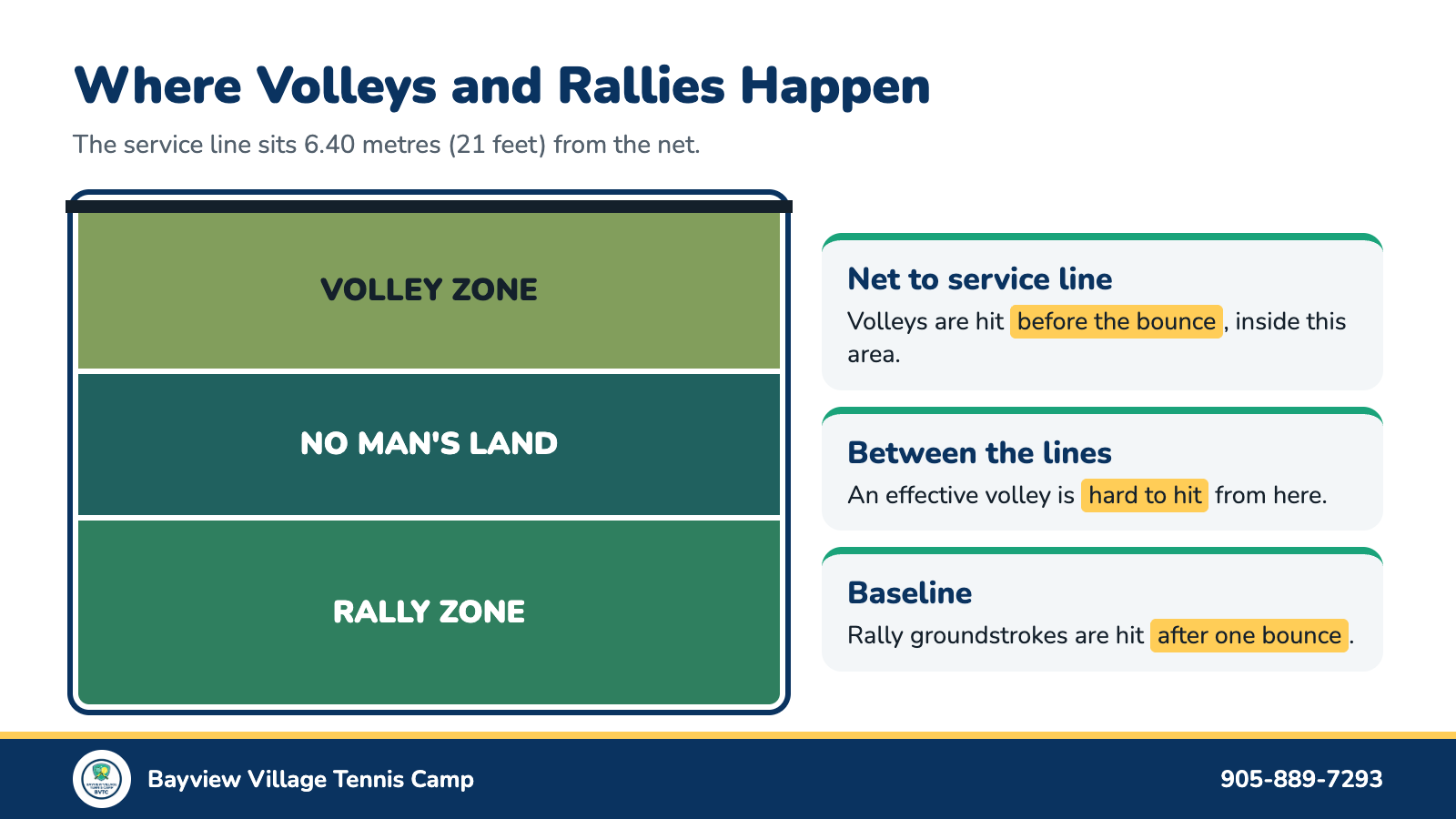
The graphic labels three zones. Volleys come from the zone near the net, and rallies run from the baseline. The area between the two is called “no man’s land”, where a volley is hard to hit well.
Our coaches build net play step by step. They start with a short, steady contact and then add the volley technique that a junior player can repeat. The full how-to sits in its own guide, so here we stay on definitions.
Footwork comes next for every young player. The UTR Sports guide calls the split step the start of every volley. Our split step guide shows the timing in plain words.
What Else Should You Know About Rallies and Volleys?
What Is No Man’s Land in Tennis?
No man’s land in tennis is the area between the baseline and the service line. An effective volley is difficult to hit from there.
Can You Volley From the Baseline?
Yes, a player can volley from the baseline, but it is uncommon. A ball still in the air that far back is likely to land long.
What Is a Low Volley?
A low volley is a volley struck at a lower contact level. That contact calls for bent knees and good control.
What Is a Passing Shot?
A passing shot is a groundstroke driven past an opponent at the net. The passing shot and the lob are the two main ways to counter a volley.
Frequently Asked Questions About Rallies and Volleys
What Is a Volley in Tennis for Beginners?
A volley is any shot played in the air before a bounce. The USTA suggests the continental grip and contact to the side of the body. The cue “squeeze and freeze” keeps the motion simple.
Why Don’t People Serve and Volley Anymore?
Serve and volley is rarer today because racquet and string technology improved groundstrokes and passing shots. Those changes favour baseline rallies over quick net play.
What Is the Half Volley in Tennis?
The half volley in tennis is a shot hit immediately after the bounce, while the ball is still rising. Players use the continental grip, a short backswing and a low body position. The shot is also called a short hop.
Does a Volley Need a Long Swing?
No, a standard volley keeps the backswing short and finishes with a punching motion. A longer backswing belongs to the swing or drive volley on a slower ball. The compact version is the standard volley.
How Bayview Village Tennis Camp Teaches Rallies and Volleys
We teach rallies and volleys to juniors and adults in North York, from the first groundstroke to the first volley. Children can join our kids day camps and practise rallies with peers on court. Certified coaches guide every session, so each child gets feedback on contact and footwork.
Players who want a closer look at one shot can book personal coaching and work on the volley with a coach. A single lesson can isolate the grip, the split step or a drop volley. The plan follows the player’s level and goals.
Adults can start with group classes where players practise rallies and net play. Club players use the same ideas as juniors. The pace of each drill matches the skill level in the group.
Meet our coaching crew to see how Tennis Canada certified coaches teach volleys at every level.
Call 905-889-7293 to ask about a spot.