What happens when a serve hits a player in tennis comes down to two cases. A good serve that hits the receiver before it bounces wins the point for the server. A serve that touches the net first and then the receiver is a let, so the server serves again. The International Tennis Federation (ITF) sets both rulings in its Rules of Tennis, and the same rulings apply in singles and doubles.
Key Takeaways
- The server wins the point when a good serve hits the receiver before the ball bounces.
- A serve that clips the net and then touches the receiver is a let, and the server repeats it.
- The same rulings apply when the serve hits the receiver’s partner in doubles.
- A serve that touches the server or the server’s partner is a fault.
- Receivers protect themselves by letting a clearly long or wide serve bounce.
What Happens When a Serve Hits a Player in Tennis?
When a serve hits a player in tennis, the server wins the point unless the ball touched the net first. The ITF states this in Rule 24, Case 7, which covers a ball that “has just been served” and hits the receiver. The rule adds one exception, the service let.
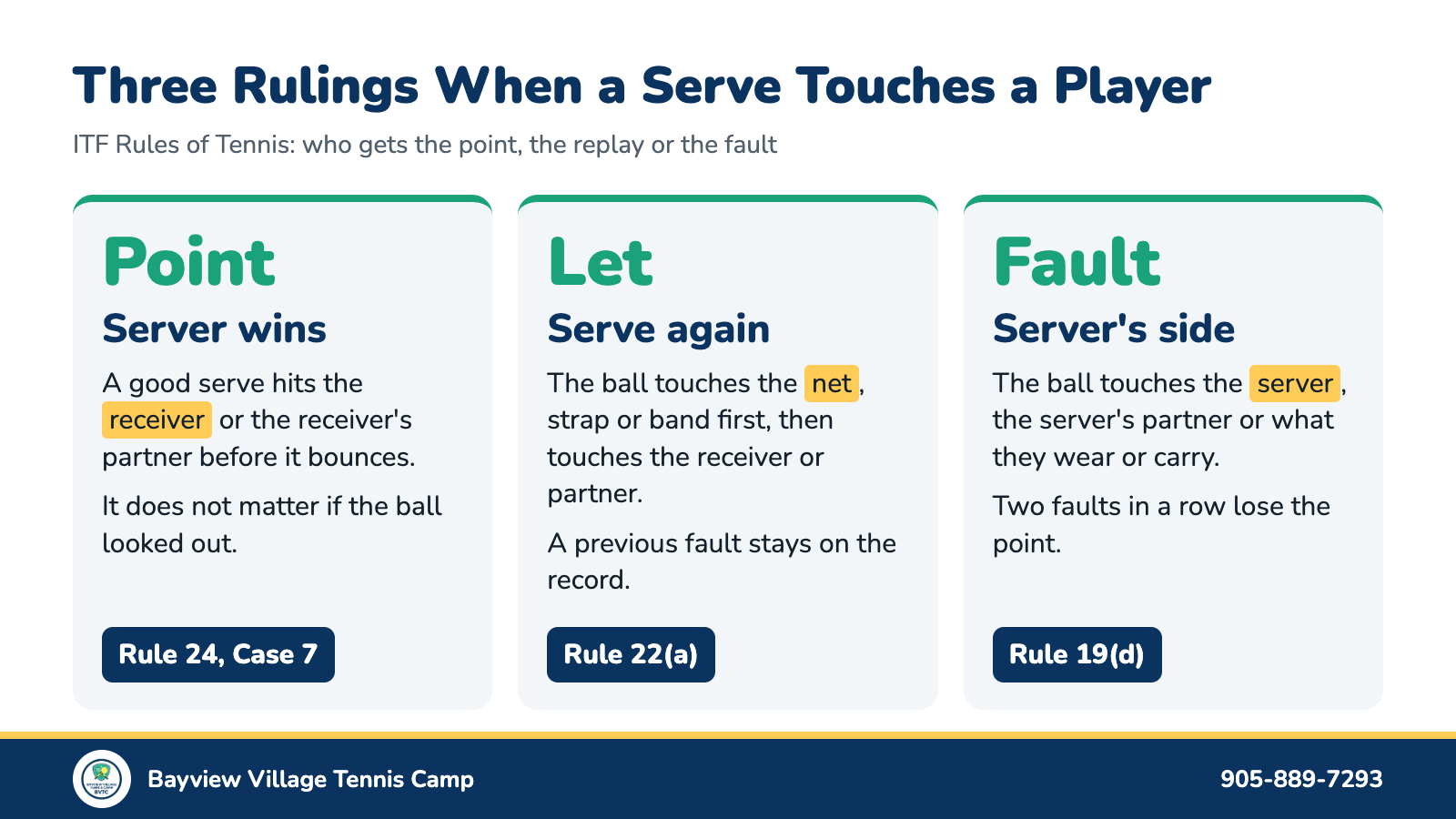
Three outcomes are possible, and each one has its own rule number. The server wins the point, the point is replayed as a let, or the serve is a fault. Our junior and adult lesson offerings teach players to spot all three on court.
The graphic below shows the three rulings side by side, with the rule number under each one.
The first ruling surprises new players, so it comes next.
Who Wins the Point When a Serve Hits the Receiver Before Bouncing?
The server wins the point when a serve hits the receiver before bouncing. The ball only has to touch the receiver before it touches the ground. Where the ball was heading does not matter.
Coaches call this the “serve hits receiver before bouncing” case. A serve that looked certain to land wide still wins the point once it touches the receiver. The ITF Rules of Tennis make no exception for a ball that looked out.
A second rule backs this up. Rule 24(i) says a player loses the point when the ball in play touches the player. Clothing and carried equipment count as part of the player, and the racket is the only exception.
Officials and coaches read the situation in four quick checks. Each check narrows the ruling to one rule number.
- Check whether the ball touched the net, strap or band first. A net touch before the contact makes the serve a let.
- Check whether the ball had touched the ground. Contact before the bounce goes to the server.
- Check who was touched. The receiver, the receiver’s partner or the server’s own side each have a separate ruling.
- Check whether the receiver hit the ball back in the air. A return before the bounce loses the point for the receiver.
The table below gathers the common cases with the matching ITF rule.
| Situation | Who is touched | Ruling | ITF rule |
|---|---|---|---|
| Good serve hits the receiver before bouncing | Receiver | Server wins the point | Rule 24, Case 7 |
| Serve heading wide hits the receiver before bouncing | Receiver | Server wins the point | Rule 24, Case 7 |
| Serve clips the net, then hits the receiver | Receiver | Let, serve again | Rule 22(a) |
| Serve hits the receiver’s partner in doubles | Partner | Server wins the point | Rule 24, Case 7 |
| Serve touches the server’s partner or clothing | Server’s side | Fault | Rule 19(d) |
| Receiver volleys the serve before the bounce | Racket | Receiver loses the point | Rule 24(e) |
Each row in the table depends on where the ball lands, which the next section explains.
Where Must a Serve Land Before the Receiver Can Play It?
A serve must pass over the net and land in the diagonally opposite service court before the receiver plays it. Rule 17 sets this order of events. The ball crosses the net, bounces in the box, and only then does the receiver hit it.
The service line sits 6.40 metres (21 feet) from the net, and the full court is 23.77 metres (78 feet) long. Our guide to court lines shows every line a server aims at. A ball that touches a line counts as touching the court that the line bounds, under Rule 12.
Readiness is the other half of the sequence. The server may not serve until the receiver is ready. A receiver who tries to return the serve counts as ready under Rule 21. New players find this order in our overview of the basic rules.
The same order explains the second serve, which comes next.
What Happens If the Server Hits the Opponent With a Second Serve?
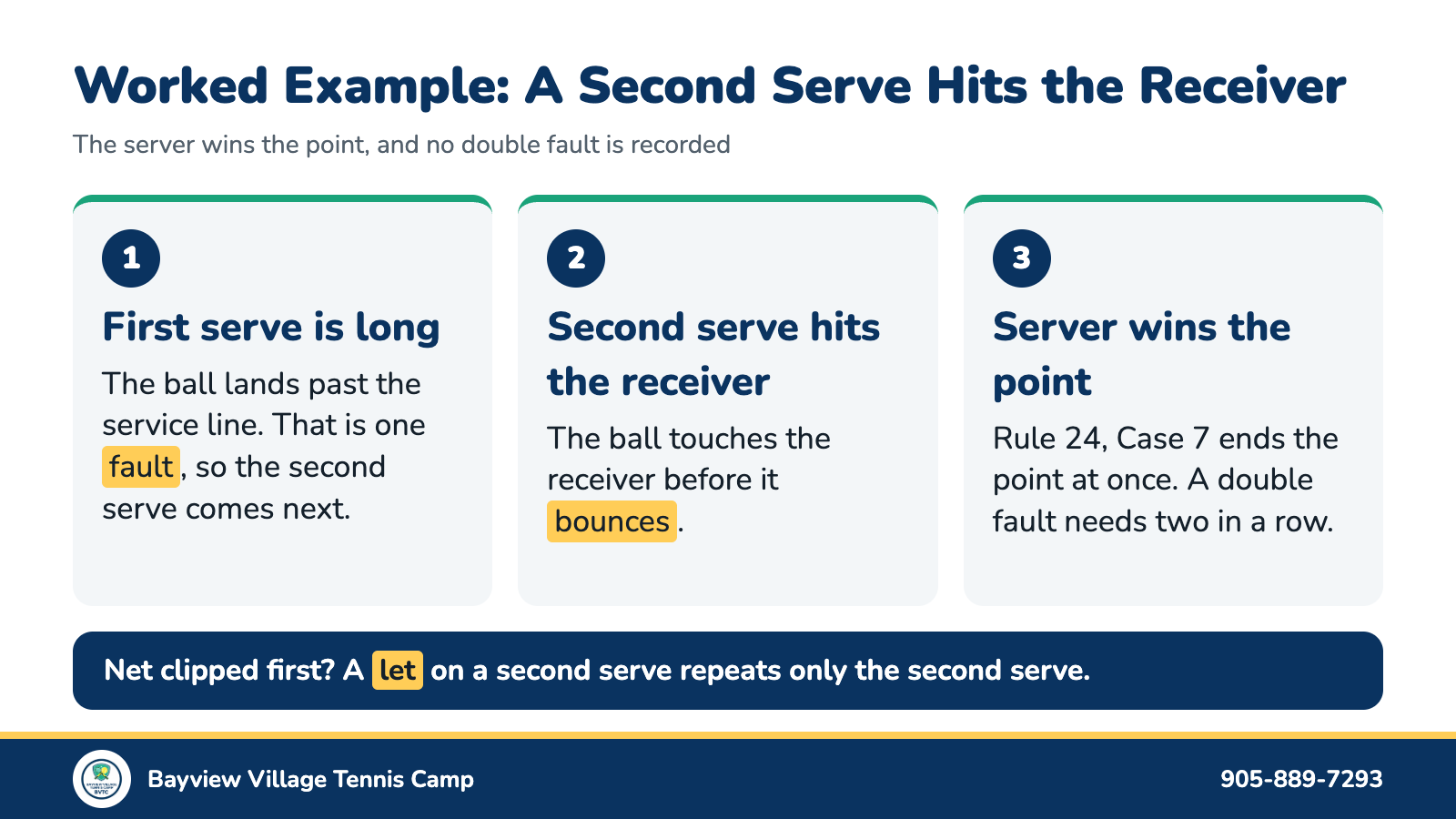
What happens if the server hits the opponent with a second serve is the same ruling: the server wins the point. Rule 24, Case 7 gives no separate treatment to a second serve. The point ends the moment the ball touches the receiver in the air.
A serve that would have been a fault still wins the point once it touches the receiver first. No double fault is recorded, because Rule 24(a) needs two consecutive faults. The contact comes before the second fault can happen.
The graphic below walks through one example, with the first serve landing long and the second serve hitting the receiver.
A let works differently from a hit, so the list below separates each case.
- A first serve that hits the receiver before bouncing gives the server the point, with no second serve.
- A first serve that clips the net and then touches the receiver is a let, and the server repeats the first serve.
- A second serve that hits the receiver before bouncing gives the server the point.
- A second serve that is a let repeats only the second serve, because a service let does not cancel a previous fault.
Servers who want fewer faults can study how to cut errors on the second chance.
A steady serve also depends on the second chance. Players who build a reliable backup serve face fewer pressure points, and fewer awkward moments for the receiver.
What Happens When a Serve Hits the Net and Then the Receiver?
When a serve hits the net and then the receiver, the serve is a let and the server serves again. Rule 22(a) makes the net contact the deciding fact. The ball must touch the net, strap or band first. It must then touch the receiver, the partner or their clothing before it lands.
Coaches teach “serve hits net then receiver” as the one exception to the server-wins rule. Players on the receiving side can feel the ball change direction, but the umpire decides the call. The centre of the net is 0.914 metres (3 feet) high. A clipped serve can change direction and land on a player.
A service let does not count as a serve. The server repeats that serve from the same side, and a fault already hit on that point stays on the record. Players who want to see how a point restarts can read about scoring from love to game.
A serve that touches the net and lands in the correct box without touching anyone is a let under the same rule. That case belongs to the let rules, so we keep to contact with a player here.
What Happens When a Serve Hits the Receiver’s Partner in Doubles?
When a serve hits the receiver’s partner in doubles, the server’s team wins the point. Rule 24, Case 7 treats “serve hits receiver’s partner in doubles” exactly like a hit on the receiver. The partner counts as part of the receiving team.
The net-first exception applies to the partner too. A serve that touches the net and then the partner is a service let, and the server serves again. Rule 22(a) names the receiver’s partner in its wording.
The diagram below shows a doubles court from above, with the service line placed 6.40 metres (21 feet) from the net. It marks where a partner stands when a serve passes close by.
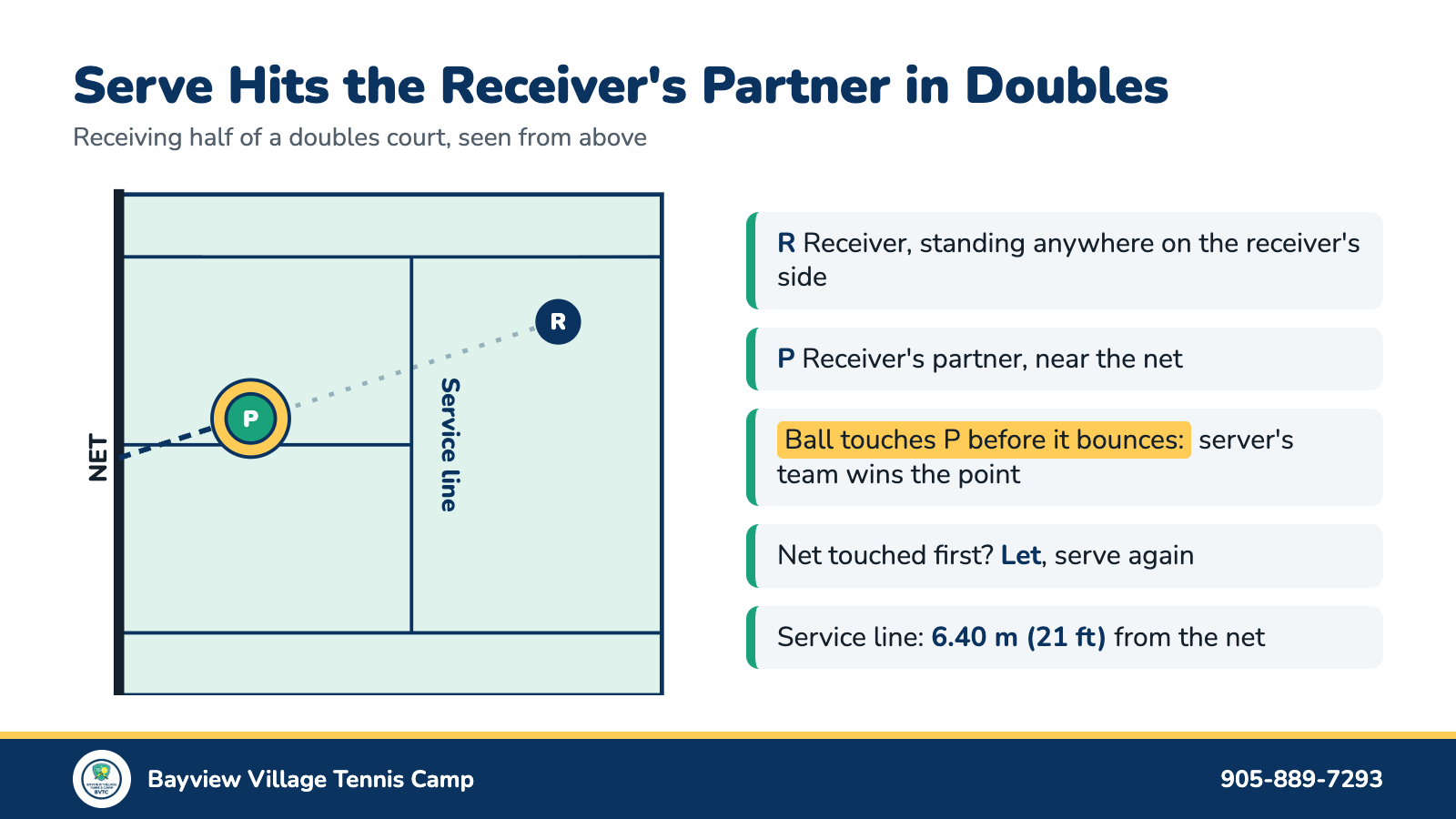
Partners at the net sit close to the path of the serve, so clear signals help. Our notes on doubles partner positions explain who covers which area. The receiver may stand anywhere on the receiver’s side of the net, inside or outside the lines, under Rule 8, Case 1.
The server’s own side has a different ruling, which the next section covers.
What Happens When the Serve Touches the Server’s Own Partner?
When the serve touches the server’s own partner, the serve is a fault. Rule 19(d) names the server, the server’s partner and anything either person wears or carries. The ball does not have to cross the net for this fault to apply.
The server then plays the second serve from the same half of the court, under Rule 20. A second fault in a row loses the point, as Rule 24(a) states, so players work to reduce second-serve errors.
This ruling is the mirror image of the receiver case. A touch on the receiving side helps the server, while a touch on the serving side costs the server a serve. Doubles partners who stand near the centre line during the toss should keep clear of the ball’s path.
Do the Tennis Rules Allow Hitting an Opponent on Purpose?
The tennis rules allow a serve to hit an opponent, and the ruling is a point for the server. The phrase “tennis rules hitting opponent” covers a point decision, not a penalty. A contact ruling does not add a warning or a fine.
Etiquette fills the gap that the point rules leave. In our lessons, we ask the server to raise a hand and apologize after an accidental hit. Juniors learn this habit early, along with the rest of court manners.
Respect for the opponent also keeps matches friendly in junior and adult club play. A quick wave or a short “sorry” settles the moment, and play moves on to the next point.
Parents ask whether a hit serve means a warning for their child. The rules answer no, because the ruling is only the point. Our coaching uses the moment to practise calm reactions, since a composed player returns to the next serve ready.
How Should Juniors Handle a Serve Aimed at Their Body?
Juniors should handle a serve aimed at their body by moving the feet and letting the ball bounce. A receiver should let a clearly long or wide serve bounce rather than catching it or blocking it with the body. That guidance follows directly from Rule 24.
The routine below works for first lessons and for adult beginners.
- Watch the toss and track the ball from the server’s hand.
- Step away from a serve that is clearly heading out of the box.
- Keep the racket back and the hands off the ball until the bounce.
- Return the serve only after it lands in the service box.
Slower balls give juniors more time to read the bounce. The ITF describes the red ball as 75% slower than a yellow ball, and our red tennis guide explains the stages.
A calm routine also builds a strong return. Players who wait for the bounce set up a cleaner return and lose fewer points to early contact.
What Else Should You Know About Serves That Hit a Player?
Is Volleying the Serve Allowed in Tennis?
No, volleying the serve is not allowed, and the receiver loses the point. Rule 24(e) lists an early return of the service as a point lost. The serve does not have to be a good one, so a ball heading out still costs the point. Players can build a patient serve return to avoid this error.
What Happens If the Ball Hits You During a Rally?
A ball in play that touches you during a rally costs you the point. Rule 24(i) covers the player, clothing and anything the player carries, and only the racket is excepted. The rule applies to every shot after the serve.
Is It a Fault If the Serve Hits You After a Bounce Out of the Box?
A serve that bounces outside the service box is already a fault. Rule 17 requires the serve to land in the diagonally opposite service court before the receiver returns it. A later touch on the receiver changes nothing, and Case 7 applies only before the ball touches the ground.
Can a Serve Hit a Player Who Is Not Ready?
A serve that is hit before the receiver is ready is a let. Rule 22(b) states this, and the server serves again. A receiver who swings at the serve counts as ready, so a late complaint does not change the point.
Frequently Asked Questions About a Serve Hitting a Player
What Is a Fault When Serving in Tennis?
A fault is a serve that breaks the rules of the service. Examples include foot faults, a missed swing at the ball, and a ball that touches a net post. A ball that touches the server or the server’s partner is a fault too. Two faults in a row lose the point.
Can You Hit the Net in Tennis on a Serve?
Yes, a serve can touch the net, and the result depends on where the ball goes next. A ball that touches the net and is otherwise good is a let. A ball that touches the net and then touches the receiver is also a let.
How Many Serves Are Allowed in Tennis?
Each point gives the server two chances to put the ball in play. A let does not use up a chance. Contact with the receiver before the bounce ends the point and gives it to the server.
How Bayview Village Tennis Camp Coaches Players on Serve Rules
Bayview Village Tennis Camp coaches players of every age on the serve rules, the return and the habits that keep matches fair. Our Tennis Canada certified coaches run junior summer camp, fall and spring junior programs, private lessons, adult group lessons and memberships. Players in North York can practise these rulings on court with a coach beside them.
Families who want a full schedule can compare our program options and pick the age group that fits. Learning what happens when a serve hits a player in tennis takes a few minutes, and match play makes the rulings stick.
Join one of our BVTC lessons and put these rulings to work in real points.
Call us at 905-889-7293 to book a spot or ask about the right level for your player.